The Big Push! The Tech Behind the I-376 Commercial Street Bridge Project
By Tim Hayes
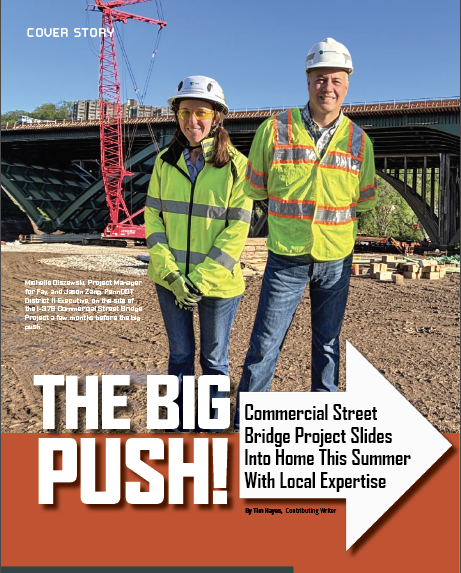 Traffic rolled along as always, across the bridge pouring commuters into the Squirrel Hill Tunnel on their way toward Downtown. Motorists knew little of the gargantuan steel structure taking shape just off to the side, until cranes broke the sight line, rising like a herd of metal brontosaurus.
Had we witnessed the birth of the Jurassic Parkway? Not exactly, although the nearly 75-year-old Commercial Street Bridge along I-376 – the heavily traveled route more commonly referred to as the Parkway East – certainly had approached the point of extinction and needed to be replaced.
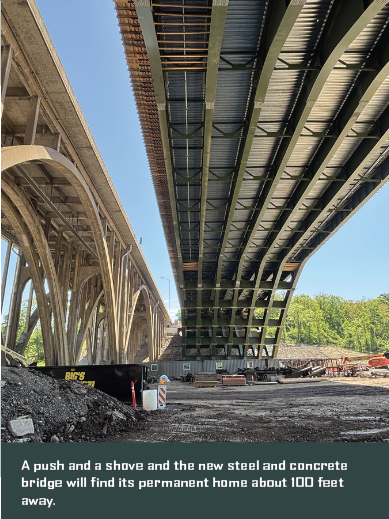
The solution, overseen by the Pennsylvania Department of Transportation (PennDOT), designed by HDR Engineering, and built by Fay, S&B USA Construction – all drawing on locally based talent and materials – comes via a specialized process known as accelerated bridge construction (ABC). Using ABC, a complete replacement bridge, built beside the existing roadway, will be pushed and slid into place, once the old structure has been removed.
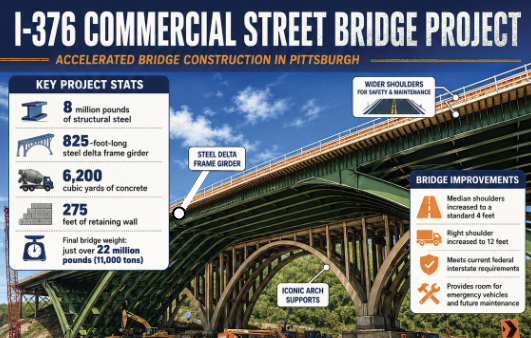
The project will use 8 million pounds of structural steel, including an 825-foot-long steel delta frame girder, 6,200 cubic yards of concrete, and 275 feet of retaining wall. The median shoulders will be increased to a standard 4 feet and the right shoulder to 12 feet to adhere to current federal interstate requirements, allowing space for emergency vehicles and future maintenance.
“We’ve been exploring and using different types of accelerated bridge construction methods here for the last easily 15, maybe even 20 years,” said Jason Zang, PennDOT District 11 Executive. “We’ve slid bridges in from the side before, we’ve built bridges like modular construction, where they come out in big pieces and are put together quickly. This is the first major bridge we’re going to be replacing in District 11 on an interstate of this magnitude with 100,000 vehicles a day, so we had to be creative.”
 When the existing bridge is ready to be removed and the new bridge ready to be positioned into place, the Parkway East will be closed to all traffic in both directions for nearly a month, starting July 10.
“A month of closing the parkway is unprecedented,” Zang acknowledged. “But we really do believe that this is way better than any other way to replace this bridge. I think people will probably remember the scope of this, of moving something this massive. It’s hard to really even understand what we’re about to do, unless you go down underneath the bridge and look at it for yourself and say, wow, look at it, look at the size of this thing.”
“PennDOT doesn’t know if it’s the longest or the tallest, or the biggest, but they believe it’s got to be one of those,” said Michelle Olszewski, Project Manager for Fay, the lead contractor. “I think that the state really took into account the fact that they didn’t want to impact traffic, and so this was their way of using a unique solution to try to keep the impact to the traveling public to a minimum. A total parkway closure seems like a lot, but in the grand scheme of things, if you were to traditionally build this bridge it would take you a lot longer – probably about four years of intermittent interruptions and closures.”
Why July? A number of reasons, all of which become apparent when you think about it, said Zang. “The best time of year from a traffic perspective is between Christmas and New Year’s, but the problem with that is you’re taking a big chance with the weather. In July, you’ve got the best chance for weather, plus kids and teachers are out of school, and a lot of people go on vacation.
“This project’s unique, where we said this closure needs to happen on July 10th through August 3rd,” he said. “We’ve actually put it in the contract, so they’ve been working towards that because if that gets delayed, now you’re talking about Pitt, CMU, Duquesne, all the universities with kids coming back to school, and it really starts to impact the region. There’s never a good time to shut anything down in Pittsburgh, but you’ve got to kind of pick the least inconvenient option.”
Once completed, the new bridge will weigh just over 22 million pounds (11,000 tons) and slid into place using ABC techniques. The new structure is built on temporary foundations. Permanent foundations under the existing bridge will be built using micropiles due to the low clearance. The temporary foundations will be removed at the end of the project after the new bridge has been moved onto the permanent foundations. The deck and floor system of the old bridge will be removed conventionally. The only part of the existing bridge to come down with explosive charges are the existing arches. All involved agree, there’s no margin for error.
 A specialty sub-contractor will handle the blasting, with all remaining demolition work done by Fay. The new structure currently sits about 20 feet away from the existing bridge, so the removal and demotion will require careful planning and execution. Protective shielding will prevent damage to the new bridge and foundations. Once the old bridge has been safely removed, a proprietary system will use a track and a system of 42 hydraulic jacks sitting on Teflon plates to push the new bridge into place. Moving about 10 feet an hour, the structure needs to move about 100 feet total.
“The new structure must be set in place, with a quarter of an inch clearance on either end,” Olszewski explained. “Engineers will be on hand to help troubleshoot anything that looks like a problem. We will be casting in place the approach slabs that lead into the bridge, so once that bridge is set, that should give you a nice, clean ride.”
“It comes down to the magic of hydraulic power and minimizing friction,” said Zang. “We have tracks cast in the concrete and a Teflon sliding surface to cut the coefficient of friction down to as close to zero as they can get it. This specially made system is coming across the Atlantic Ocean from the Netherlands. It lifts the bridge at various locations, and then it slides it sideways, sets it back down, and then the sliding jacks reset themselves. Push it three feet, reset, push it three feet, reset, in a very slow process.”
After the slide, Fay will begin restoring the area beneath the bridge, rebuilding the stream, planting more than 5,000 trees and shrubs, regrading the topography, re-establishing the Nine Mile Run trail, and returning Commercial Street back to its original alignment. This work will continue into 2027.
“This project’s unique, where we said this closure needs to happen on July 10th through August 3rd,” he said. “We’ve actually put it in the contract, so they’ve been working towards that because if that gets delayed, now you’re talking about Pitt, CMU, Duquesne, all the universities with kids coming back to school, and it really starts to impact the region. There’s never a good time to shut anything down in Pittsburgh, but you’ve got to kind of pick the least inconvenient option.”
The involvement of local talent plays a major role, as Olszewski commented. “Right now we have over 50 subcontractors. We also pull from our local union trades, so we have laborers, operators, carpenters, cement masons, pile drivers, people running the job like project managers, project engineers, superintendents, and foremen. We also have support staff in our office, along with people that can help us with survey, drone footage, and scheduling. We have a design engineer and specialty contractors to help us with the slide itself, in addition to the other subcontractors to help build the project. Most of our subs and suppliers are local to Pittsburgh, including the steel used for the bridge railing and drainage. For us as a construction company, local’s always better because it’s closer, so we try to do as much as we can with the resources we have nearby.”
“I’d say 90% of this project, maybe even more than that, is all local people,” echoed Zang. “Our designer, HDR Engineering, has a very strong local and historic presence in Pittsburgh. They actually designed a lot of the most iconic bridges around Pittsburgh. Fay, S&B USA is all local talent. We work with this group on project after project. They have rehabbed many of the major bridges in Pittsburgh, like the Liberty Bridge and Birmingham Bridge, just to name a couple. They also had a huge part in the Pittsburgh airport, which is another big, iconic project. Our team at District 11, we’re all local. So, local people building for their own community, it’s really special.”
As the Parkway East gets taken out of service, Zang suggested using PRT public transit, carpooling, or remote work to minimize traffic delays. “The official posted detours are on state roads. Hopefully the public stays mindful that there could be kids out playing or people walking through their neighborhoods. Remember, you’re no longer driving on an interstate.
“We thank the public for their patience,” he concluded. “This project is like shining a light on the talent and the know-how of Pittsburgh. City of Bridges, here we go!