Delivering Data Centers at the Speed the Market Demands
By Michael E. Archer, P.E., CEC
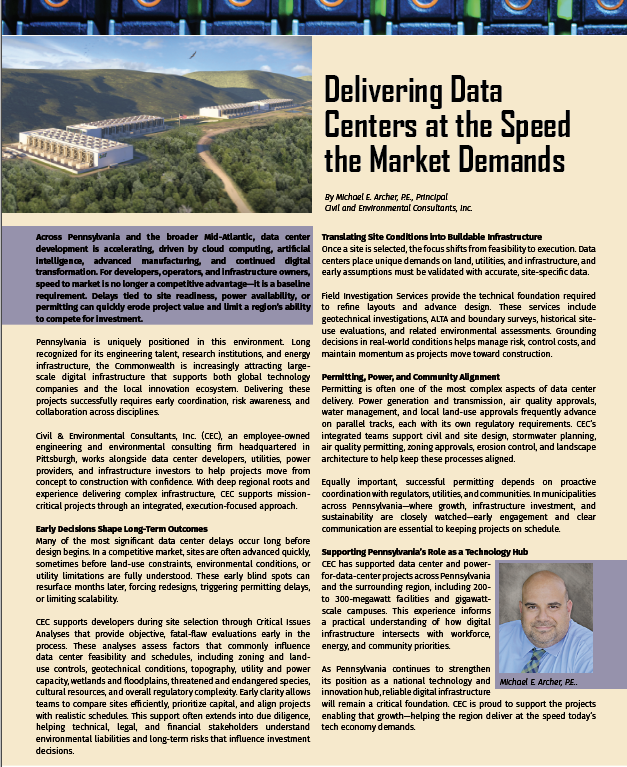 Across Pennsylvania and the broader Mid-Atlantic, data center development is accelerating, driven by cloud computing, artificial intelligence, advanced manufacturing, and continued digital transformation. For developers, operators, and infrastructure owners, speed to market is no longer a competitive advantage—it is a baseline requirement. Delays tied to site readiness, power availability, or permitting can quickly erode project value and limit a region’s ability to compete for investment.
Pennsylvania is uniquely positioned in this environment. Long recognized for its engineering talent, research institutions, and energy infrastructure, the Commonwealth is increasingly attracting large-scale digital infrastructure that supports both global technology companies and the local innovation ecosystem. Delivering these projects successfully requires early coordination, risk awareness, and collaboration across disciplines.
Civil & Environmental Consultants, Inc. (CEC), an employee-owned engineering and environmental consulting firm headquartered in Pittsburgh, works alongside data center developers, utilities, power providers, and infrastructure investors to help projects move from concept to construction with confidence. With deep regional roots and experience delivering complex infrastructure, CEC supports mission-critical projects through an integrated, execution-focused approach.
Early Decisions Shape Long-Term Outcomes
Many of the most significant data center delays occur long before design begins. In a competitive market, sites are often advanced quickly, sometimes before land-use constraints, environmental conditions, or utility limitations are fully understood. These early blind spots can resurface months later, forcing redesigns, triggering permitting delays, or limiting scalability.
CEC supports developers during site selection through Critical Issues Analyses that provide objective, fatal-flaw evaluations early in the process. These analyses assess factors that commonly influence data center feasibility and schedules, including zoning and land-use controls, geotechnical conditions, topography, utility and power capacity, wetlands and floodplains, threatened and endangered species, cultural resources, and overall regulatory complexity. Early clarity allows teams to compare sites efficiently, prioritize capital, and align projects with realistic schedules. This support often extends into due diligence, helping technical, legal, and financial stakeholders understand environmental liabilities and long-term risks that influence investment decisions.
Translating Site Conditions into Buildable Infrastructure
Once a site is selected, the focus shifts from feasibility to execution. Data centers place unique demands on land, utilities, and infrastructure, and early assumptions must be validated with accurate, site-specific data.
Field Investigation Services provide the technical foundation required to refine layouts and advance design. These services include geotechnical investigations, ALTA and boundary surveys, historical site-use evaluations, and related environmental assessments. Grounding decisions in real-world conditions helps manage risk, control costs, and maintain momentum as projects move toward construction.
Permitting, Power, and Community Alignment
Permitting is often one of the most complex aspects of data center delivery. Power generation and transmission, air quality approvals, water management, and local land-use approvals frequently advance on parallel tracks, each with its own regulatory requirements. CEC’s integrated teams support civil and site design, stormwater planning, air quality permitting, zoning approvals, erosion control, and landscape architecture to help keep these processes aligned.
Equally important, successful permitting depends on proactive coordination with regulators, utilities, and communities. In municipalities across Pennsylvania—where growth, infrastructure investment, and sustainability are closely watched—early engagement and clear communication are essential to keeping projects on schedule.
Supporting Pennsylvania’s Role as a Technology Hub
CEC has supported data center and power-for-data-center projects across Pennsylvania and the surrounding region, including 200- to 300-megawatt facilities and gigawatt-scale campuses. This experience informs a practical understanding of how digital infrastructure intersects with workforce, energy, and community priorities.
As Pennsylvania continues to strengthen its position as a national technology and innovation hub, reliable digital infrastructure will remain a critical foundation. CEC is proud to support the projects enabling that growth—helping the region deliver at the speed today’s tech economy demands.