Rockets, Race Cars, and Roller Coasters: Inside Pittsburgh’s Ultimate Testing Lab
For most people, the proverbial three Rs are Reading, ‘Riting, and ‘Rithmetic.
For Clark Testing, the three Rs are Rockets, Race Cars, and Roller Coasters.
It’s a line that gets a smile—but it’s no exaggeration. Tucked along Route 51 in an unassuming industrial building, Clark Testing has become one of the most important proving grounds for advanced technology in the country. Inside, products destined for space, theme parks, racetracks, rail systems, and even nuclear power plants are pushed to their limits—long before they ever reach the real world.
And sometimes, they don’t survive.
“That’s the point,” says CEO Paul Heffernan. “We put products into the environments they’re going to experience in the field—whether that’s vibration, shock, or long-term wear—and make sure they can handle it.”
Breaking Things—So They Don’t Break Later
 Clark Testing specializes in what’s known as equipment qualification (EQ)—the final validation stage for products before they go to market. Engineers bring their prototypes to Clark’s labs to answer one critical question: Will this actually hold up?
To find out, Clark doesn’t just test products—it accelerates reality.
Components are subjected to extreme vibration, temperature shifts, electromagnetic interference, and mechanical stress, simulating years of wear in a matter of hours. Whether it’s a rail system enduring constant motion, a component mounted deep inside a Navy vessel, or critical infrastructure designed for a nuclear facility, Clark recreates the exact conditions those systems will face.
In some cases, the company’s seismic testing capabilities—among the largest in the United States—simulate earthquakes to ensure mission-critical equipment performs under pressure.
“It’s about confidence,” Heffernan explains. “Our customers need to know that when their product is deployed, it’s going to do exactly what it’s supposed to do.”
A New Level of Scale
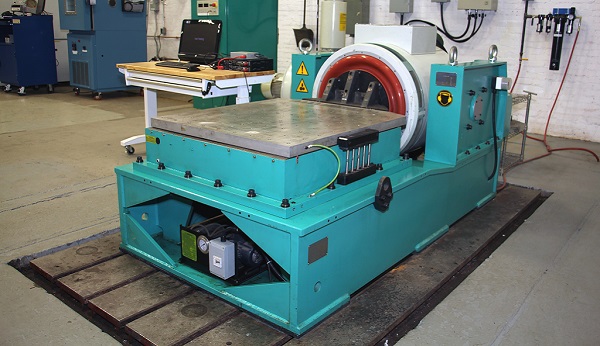 That mission just got a major upgrade.
Clark Testing recently unveiled the Spectral Dynamics SD44 shaker system—one of the largest and most advanced of its kind in the country. With the ability to deliver 44,000 pounds of force across a testing platform up to 15 feet wide, the system dramatically expands what the company can handle.
Think large-scale systems: rail car components, aerospace assemblies, and even equipment destined for lunar missions.
“This gives us the ability to test bigger, more complex products at higher frequencies and higher force levels,” says Heffernan. “It’s a game-changer for our customers.”
The roughly $1.5 million investment was made possible through a mix of private commitment and regional support (PA Senator Devlin Robinson), including partnerships with financial institutions and economic development organizations. It’s a testament not just to Clark’s growth, but to the region’s belief in advanced manufacturing and testing as a competitive advantage.
A Global Front Door for Pittsburgh
While Clark Testing’s roots are firmly planted in Western Pennsylvania, its reach is global.
Engineers and companies from around the world travel to Pittsburgh to validate their designs. On any given day, the facility may host teams from major defense contractors, global rail companies, or cutting-edge aerospace firms—all working side-by-side in Clark’s labs.
“It’s not uncommon to have customers here from Europe, Asia, and across the U.S.,” says Heffernan. “They’re coming to Pittsburgh because they know we can do the testing they need.”
That global draw reinforces something longtime industry insiders already know: Pittsburgh is more than a legacy manufacturing city—it’s a center of excellence for industries like rail, energy, and advanced engineering.
Clark sits right at the intersection of that ecosystem, supporting companies like Wabtec, Mitsubishi Rail, Siemens, and others that continue to build on the region’s industrial DNA.
Built on Pittsburgh Grit
Clark Testing’s story is also a classic Pittsburgh one.
Founded in 1992 with just six cars in the parking lot, the company grew by acquiring and preserving specialized testing capabilities that might otherwise have disappeared as larger corporations restructured. Over time, it built a team of highly skilled technicians and engineers—many with decades of experience—who bring both precision and craftsmanship to their work.
Today, Clark employs more than 100 people across multiple facilities, including two in Pittsburgh.
And that expertise matters.
“These tests are complex,” Heffernan says. “You need people who understand not just the equipment, but the science behind what’s happening. That’s what sets us apart.”
Where Innovation Gets Proven
For all the complexity inside Clark Testing’s labs, the mission is straightforward: make sure innovation works when it matters most.
Whether it’s a spacecraft component heading into deep space, a rail system carrying passengers through a city, or a safety system designed to shut down a nuclear plant during an emergency, the stakes are high.
Clark Testing ensures those systems are ready.
Because in the end, it’s not enough to design something brilliant.
It has to survive the real world.
And in Pittsburgh, there’s a place that makes sure it does.