The New Empire of Lights - Exploring Local Tech, Investments and Innovation For Data Centers
Pennsylvania’s AI and data center moment is no longer theoretical. It is being built right now through a powerful convergence of energy, manufacturing, infrastructure, and innovation. At the Pittsburgh Technology Council’s PA Data Center Summit, executives, developers, utilities, manufacturers, and technology leaders laid out what it will take to turn the Commonwealth into a serious force in the next era of digital and industrial growth.
The stories that follow capture that momentum from multiple angles: the manufacturers producing the equipment that will modernize the grid, the developers reimagining legacy power sites for AI-ready infrastructure, the engineers and utilities solving for fiber, interconnection, and reliability, the energy companies racing to meet surging demand, and the innovators inside the data center pushing optical and computing technologies forward. Together, they tell a bigger story about Pennsylvania’s opportunity to do more than host the AI economy. The Commonwealth has a chance to help power it, build it, and shape it.
EMPIRE of LIGHTS
Western Pennsylvania is helping build the electrical backbone to make data centers and the needed energy happen!
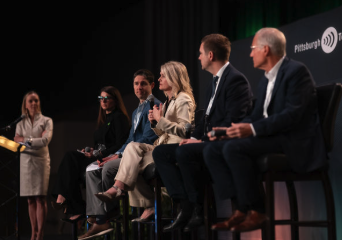 The “Empire of Lights” panel at the PA Data Center Summit made one thing clear: Western Pennsylvania is not just watching the AI and data center boom unfold, it is helping build the electrical backbone that will make it possible. Moderated by Justine Kasznica of Babst Calland, the discussion connected the region’s historic legacy in power innovation to a new era defined by grid modernization, advanced manufacturing, energy storage, and the race to meet unprecedented demand for reliable electricity.
The panelists represented a powerful cross-section of companies supplying the components and systems now essential to this buildout. Michelle Buczkowski of Eos Energy described how her company is producing long-duration zinc-based battery storage systems in Turtle Creek, on the historic Westinghouse footprint, while expanding with a new facility in Warrendale. John Campion of Mitsubishi Electric Power Products highlighted the company’s $86 million investment in a new Beaver County switchgear facility and expanded power electronics capabilities. Angie McMillin of Eaton pointed to the company’s deep Pittsburgh roots, regional manufacturing footprint, and growing role in serving data centers from the grid all the way down to the chip. Andreas Wrener of Hitachi Energy emphasized the company’s major investments in high-voltage infrastructure and manufacturing expansion in the region, while Bob Yeager of Emerson underscored the role of automation and control systems in managing increasingly complex power environments.
A major theme throughout the conversation was that AI and data centers are not simply creating more demand for electricity. They are changing the very nature of that demand. Panelists described a world where speed, reliability, and flexibility matter as much as sheer power volume. That reality is accelerating innovation across the sector, from battery energy storage and microgrid controls to liquid cooling, DC architecture, and smarter systems for balancing rapidly shifting loads. In short, the data center boom is forcing the energy and manufacturing ecosystem to rethink how power is generated, distributed, stored, and controlled.
Just as important, the panel made a strong case for why Pennsylvania, and especially Western Pennsylvania, is well-positioned to lead. The region offers a rare combination of industrial heritage, available sites, skilled labor, engineering talent, and supply chain depth. Multiple speakers also noted that bipartisan support, local partnerships, and ties to institutions like Carnegie Mellon and the University of Pittsburgh are helping create the kind of environment where companies can scale quickly and invest confidently.
Still, the panelists were candid about the challenges ahead. Power availability, workforce development, permitting speed, and the willingness to adopt new technologies were all cited as critical hurdles. But the tone of the discussion was unmistakably optimistic. The consensus was that if the region can move fast enough and continue building talent, infrastructure, and capacity, Western Pennsylvania can become a lasting hub for the technologies powering the next industrial age. As Kasznica put it in closing, the region is helping build a new “Empire of Lights.”
Built on Bedrock
How Homer City is transforming a former coal plant into one of Pennsylvania’s boldest AI-era energy infrastructure projects
 When Corey Hessen took the stage to talk about Homer City, he wasn’t just presenting a redevelopment update. He was telling the story of how one of Pennsylvania’s most iconic legacy power sites is being reengineered for a new industrial age, one defined by AI, data centers, and the race for reliable, large-scale energy.
For decades, Homer City was known as Pennsylvania’s largest coal-fired power plant, a towering presence in Indiana County and a fixture in the lives of the people who lived and worked around it. When the plant closed in 2023, it could have become another story of industrial decline. Instead, Hessen and his team saw something else: a rare opportunity to transform a former coal site into a next-generation energy campus capable of supporting one of the largest AI-ready infrastructure projects in the country.
That vision is now taking shape at a remarkable scale. Hessen outlined a plan centered on a 4,500-megawatt gas-fired power block, dual pipeline redundancy, a major switchyard, water infrastructure, and roughly 800 acres of developable land designed to host future high-energy users. Altogether, the project represents more than $10 billion in investment and positions Homer City as a flagship example of the “bring your own power” model increasingly shaping large-scale data center development. It is not just about generating electricity. It is about delivering certainty, speed, and resilience in a market where all three have become competitive advantages.
What made Hessen’s presentation especially compelling was his emphasis on the less glamorous side of transformation: timing, logistics, relationships, and execution. He made clear that projects like this are won long before the public sees demolition footage or construction equipment. Homer City moved early, securing seven GE Vernova turbines before supply chains tightened even further and building partnerships with contractors, regulators, and local stakeholders well in advance. That foresight is already paying off. The site has moved millions of cubic yards of earth, secured key permits at unusual speed, and is preparing for a workforce that could swell to 3,500 during peak construction.
Still, Hessen never let the story drift too far into megawatts and machinery. He returned repeatedly to the idea that this project is ultimately about people. He spoke about the emotional weight of the plant’s closure, the significance of bringing opportunity back to Indiana County, and the importance of treating rural communities not as afterthoughts, but as essential to Pennsylvania’s future. In that sense, Homer City is more than a redevelopment project. It is a statement that the communities that powered America’s past can also help power its AI future.
Building the Grid Beneath the Cloud
The future of data centers depends on the engineers, utilities, and regulators solving infrastructure bottlenecks in real time
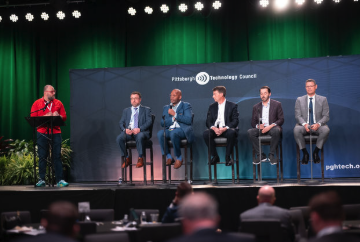 If the AI boom is the headline, infrastructure is the fine print that determines whether any of it actually gets built.
That was the central message of “The Infrastructure of Data Centers,” a panel moderated by Expedient Field CTO AJ Kuftic that pulled the conversation out of the realm of hype and into the harder realities of execution. The discussion focused on the physical and regulatory systems that have to align before a major data center project can move from concept to operation: power generation, grid interconnection, gas delivery, fiber connectivity, cost allocation, and resilience. In other words, the panel explored the hidden machinery behind the AI economy.
One of the clearest themes was speed. Utilities and infrastructure providers are being asked to respond to load forecasts and project proposals at a pace the industry has never seen before. Duquesne Light’s Kevin Walker noted that the volume of demand tied to data centers is unlike anything utilities have previously encountered, with requests arriving faster and at larger scale than past waves like electric vehicles. PJM Interconnection’s Stephen Bennett added that it has had to rethink how generation projects are studied and approved, including efforts to create faster interconnection pathways for large new power sources that can come online quickly. The goal is simple, even if the process is not: get enough power onto the grid, fast enough, without compromising reliability.
But electricity is only one layer of the puzzle. The panel also emphasized that data centers are useless without fiber, and that Western Pennsylvania’s geography creates a more difficult and expensive path for building the redundant underground routes hyperscale operators want. Running fiber in Pennsylvania is not like laying it across a flat Texas corridor. Mountains, rivers, railroads, road rights-of-way, and municipal approvals all complicate the build. That is where the Pennsylvania Turnpike’s growing fiber strategy came into focus. The Turnpike’s CTO Bob Taylor, described efforts to turn the toll road into a kind of digital superhighway, leveraging its linear corridor and statewide footprint as a platform for commercial fiber deployment and future connectivity.
Natural gas also emerged as a critical piece of the conversation, especially for projects pursuing onsite or nearby power generation. Peoples CEO Mike Huwar framed the opportunity in terms of converting abundant in-basin methane into electrons for growing load demand, while also acknowledging the importance of affordability, reliability, and long-term supply impacts on existing customers. Throughout the panel, speakers repeatedly stressed that data center growth will only be sustainable if the costs of enabling it are assigned fairly and not simply shifted onto ratepayers. That issue, from utility tariffs to stranded infrastructure costs, remains one of the most important policy and public trust questions in the space.
Taken together, the panel made one thing unmistakably clear: data centers may be sold as digital infrastructure, but their future will be decided by very physical realities. Wires, pipes, substations, permits, rights-of-way, and regulatory frameworks are where the AI race will either accelerate or stall. And in Pennsylvania, the people building those systems are increasingly determining whether the Commonwealth can turn opportunity into lasting advantage.
Power Is the New Platform
As AI demand surges, Pennsylvania’s energy assets are becoming the deciding factor in the race for data center growth
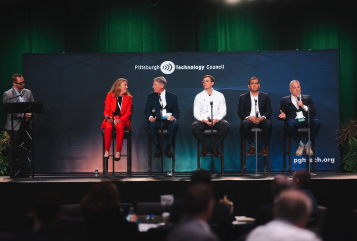 If data centers are the visible symbol of the AI economy, this panel made clear that power is the real prize.
Moderated by Emerson’s Adam Lavallee, “The Power of Data Centers” brought together energy developers, investors, and infrastructure leaders for a candid discussion about what it will take to meet the explosive electricity demands of AI and high-performance computing. The conversation was not just about megawatts. It was about competitiveness, capital, and whether Pennsylvania can turn its natural advantages into lasting economic leverage.
Across the panel, one message came through with unusual clarity: Pennsylvania has the raw ingredients to lead. Speakers pointed to the state’s abundant natural gas, existing generation assets, strong position inside PJM, deep industrial history, skilled workforce, and access to water and transmission infrastructure as major advantages in the race to support hyperscale and AI-driven development. Several panelists argued that few places in the country can match the Commonwealth’s combination of energy resources and strategic location. At the same time, there was little complacency on stage. More than one speaker warned that having the assets is not the same as winning the market.
That tension, between opportunity and urgency, drove much of the discussion. Peter Dailey of International Electric Power and others were blunt in arguing that Pennsylvania still trails states like Virginia, Ohio, and Texas in speed, policy alignment, and overall competitiveness. Permitting, utility processes, tax structure, and development timelines all came under scrutiny. The implication was unmistakable: the AI and data center wave is creating a temporary opening, but not one that will wait indefinitely for slow-moving states to catch up.
Financing was another major theme. Panelists described how long-term data center demand is already helping unlock major investment in power infrastructure, from nuclear uprates and hydropower reinvestment to new behind-the-meter generation and broader energy development. Vistra pointed to its long-term agreement with Meta as the kind of offtake support that can justify meaningful upgrades at existing plants, while Brookfield Renewable discussed how similar commitments are creating the certainty needed to reinvest in aging hydropower assets. The panel’s message was that hyperscalers are no longer just electricity buyers. In many cases, they are becoming the financial engine behind projects that might not otherwise move forward.
The discussion also widened beyond power markets to community and workforce impact. Several speakers stressed that these projects must create visible value locally, whether through school support, workforce pipelines, technical training, infrastructure improvements, or long-term job opportunities that help younger generations remain in the communities where they grew up. That emphasis gave the panel a broader frame: this is not simply a story about electrons flowing to server racks. It is also about whether Pennsylvania can capture more of the economic value from the energy it already produces.
In the end, “The Power of Data Centers” felt less like a routine panel and more like a strategic challenge. Pennsylvania has the fuel, the land, the workforce, and the grid position to become a serious player in the AI era. The question, as several speakers made clear, is whether it can move fast enough to matter.
Pennsylvania’s Place in the AI Supply Chain
The $2 Billion Coherent-NVIDIA partnership highlights how Western Pennsylvania can help build not just the power behind AI, but the technology inside it
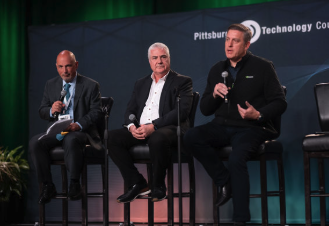 This fireside chat put a finer point on one of the summit’s biggest themes: the future of AI infrastructure will not be built by power alone. It will also depend on the optical technologies moving staggering amounts of data inside and between next-generation AI data centers, and Western Pennsylvania is right in the middle of that story.
Speaking just after the announcement of a new multiyear strategic partnership between NVIDIA and Coherent, Steve Rummel, Senior Vice President of Coherent’s Engineered Materials Group, and Shane Shaneman, Senior AI Strategist at NVIDIA, described a relationship that goes well beyond a simple supply agreement. The discussion framed the deal as both a manufacturing play and a technology play, one aimed at strengthening the domestic supply chain for the advanced optical components that AI infrastructure increasingly depends on.
Rummel used the session to remind the audience that while the Coherent name may be newer to some, the company’s roots in Saxonburg run deep. Formerly II-VI, Coherent has spent decades building a vertically integrated photonics platform, growing from a laser optics leader into what Rummel described as the largest photonics company in the world. That evolution matters because photonics now sits at the heart of AI scale. Coherent produces highly specialized components used in advanced chipmaking and optical communications, including technologies so precise that, in some cases, they are unmatched anywhere else in the world.
Shaneman widened the lens. He argued that AI should be understood as a layered system, with energy, chips, infrastructure, models, and applications all stacked together. In that framework, optical networking is not some secondary detail buried in the hardware layer. It is one of the enabling technologies that determines whether AI can scale efficiently enough to meet surging demand. As generative AI shifts the industry from model training to inference at massive scale, the infrastructure challenge becomes more urgent. Shaneman said demand for compute has risen at an extraordinary pace, and that the ability to network GPUs efficiently is now central to the AI race.
That is where the $2 Billion-Coherent-NVIDIA partnership comes into focus. Rummel explained that as AI systems scale, copper connections increasingly run into physical and efficiency limits, while optical systems offer the speed, reach, and energy savings required for the next generation of data centers. He pointed to co-packaged optics and optical switching as major steps forward, especially as lasers and optics are moved closer to the chip itself. The payoff is not just more performance, but dramatically better energy efficiency, a critical advantage when every megawatt matters.
For Pennsylvania, the significance goes beyond one deal. This conversation made the case that the Commonwealth is not only well-positioned to host the energy systems supporting AI, but also to help manufacture the technologies inside the data center itself. In other words, Western Pennsylvania is not just powering the AI economy. It is helping engineer its nervous system.