Demo Day Returns With a Fresh Look at Pittsburgh’s Startup Future
After a long pause, Innovation Works’ AlphaLab Demo Day returned with the kind of energy Pittsburgh’s startup community has been missing.
Part showcase, part reunion and part launchpad, Demo Day brought together 21 companies from AlphaLab’s latest cohort, giving founders the chance to step in front of mentors, investors, customers and ecosystem connectors to show what they have been building over the last five months.
 For Aaron Tainter, who runs AlphaLab for Innovation Works, the return of Demo Day was more than a calendar item. It was a reminder of how important the event has been to Pittsburgh’s startup ecosystem.
“We’re so excited to bring back our AlphaLab Demo Day,” Tainter said, calling it “one of the strongest startup community events here in Pittsburgh.”
At its core, Demo Day is a celebration. But AlphaLab is not built on celebration alone. Tainter said the program is designed to sharpen companies before they face the real world. Over five months, founders go through boot camps, one-on-one support, mentor sessions and hard conversations around market fit, go-to-market strategy, customers, funding and the next stage of company building.
“We’ve been working hard with these companies for over five months now, really sharpening, de-risking their business, sharpening their go-to-market and preparing for the next stage,” he said.
That preparation was on display across a cohort that reflected some of Pittsburgh’s biggest technology strengths, including AI, robotics and life sciences. Tainter said that focus is intentional. AlphaLab has evolved into a single-city, place-based accelerator designed to invest in the sectors where Pittsburgh has a competitive edge.
“We focus our efforts and our investments on the industry sectors that are great for Pittsburgh,” he said. “We think about AI, robotics and life sciences.”
Those strengths came through clearly in conversations with SeaLion Energy, MedMiro, Hermes Vision and Gratis Intelligence, four cohort companies working in very different markets but sharing the same startup reality: a good idea only matters if it can survive contact with customers, investors and the market.
SeaLion Energy: Making Batteries Last Longer
For SeaLion Energy, the pitch starts with a simple but powerful promise: batteries that last dramatically longer.
Aji Anirudham, a founding member of SeaLion Energy, said the company is building battery technology that can extend battery life by up to 10 times. That could have major implications for cost, waste, sustainability and supply chain resilience.
“What we are telling our customers, or rather trying to take our customers to the future, is that you no more replace your battery, you replace your device,” he said.
The vision is circularity. Instead of a battery dying with one device, SeaLion wants batteries to move across multiple applications before they ever reach recycling. That matters in a world increasingly powered by electric vehicles, robotics, scooters, consumer devices and industrial equipment.
The company’s origin was sparked in part by seeing massive “graveyards” of electric vehicles and recognizing the difficulty and energy intensity of battery recycling. SeaLion’s technology, backed by Department of Energy ARPA-E investment, is designed to enhance existing battery technologies rather than require a completely new manufacturing process.
For SeaLion, AlphaLab helped turn technical potential into market strategy. Anirudham said the program gave the company structure around how to approach customers, identify markets, understand costs, talk to investors and map milestones.
“It gives us a structure to actually grow the company to the next level,” he said.
The first target market is robotics, a natural fit for Pittsburgh. SeaLion sees an opportunity where robots may be designed to operate for seven years, but batteries can die much sooner, creating major total cost of ownership challenges. The company is now looking toward pilots, testing and validation.
Medmiro: Solving a Quiet but Costly Health Care Problem
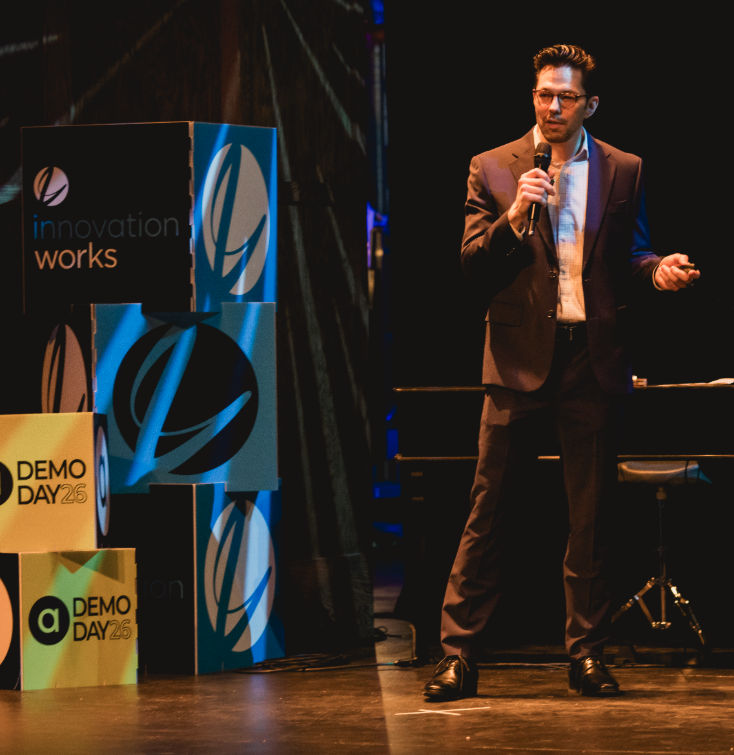 Medmiro is taking on a problem that hides in plain sight across hospitals and care settings: surgical tubes.
Founder Tyler Mirnuck described Medmiro as a platform technology to better secure and manage surgical tubes, including feeding tubes, drains, catheters and central lines. These devices may seem simple, but dislodgement is a serious issue.
Feeding tubes alone can have dislodgement rates as high as 37% per patient, creating risks around complications, infection, delayed recovery and additional care.
“We are trying to keep the tubes where they’re placed, keep them from being dislodged, and also doing it in a way that fits in with clinical workflows,” Mirnuck said.
That workflow piece is central. Existing securement devices often force a tradeoff between holding the tube in place and allowing providers to access, clean, monitor and care for the area around it. Medmiro is trying to solve both sides of that problem.
The company’s first device focuses on G-tubes, but Mirnuck sees the broader opportunity across surgical tubes, drains and catheters. He said the feeding tube market alone is projected to reach more than $5 billion by 2031.
Medmiro grew out of graduate work and several years of customer discovery, need validation, research and development. But building a startup can be lonely, especially when the early work is happening in a kitchen instead of a lab or office.
For Mirnuck, AlphaLab provided something just as important as business guidance: community.
“What’s been really refreshing, just being part of this cohort, is the support,” he said. “Finding other people that understand the grind.”
The next step is moving from proof of concept to a device ready for pilot studies. Medmiro is working with Texas Children’s Hospital and Allegheny Health Network as it develops a more comfortable, commercially manufacturable version of its first product.
Hermes Vision: Precision Weed Management From the Air
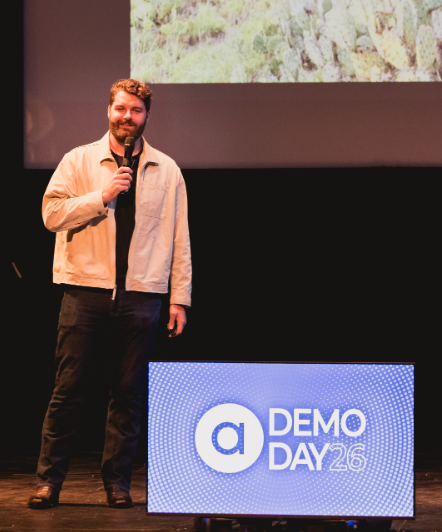 Hermes Vision sits at the intersection of AI, robotics, drones and agriculture.
Founder Grant Wilkinson said the company uses drones for precise weed management in any terrain. The goal is to drastically reduce chemical use by applying herbicide only where it is needed.
The system works in three steps. A survey drone captures imagery of plants on the ground. Hermes Vision’s AI identifies plant species and locations. That data is then packaged for a spraying drone, which applies treatment only to specific areas.
Wilkinson’s inspiration came from his family’s ranch in Texas, where he watched his mother use a backpack sprayer in brutal heat. The result is a company that brings Pittsburgh’s robotics and AI strengths to an agricultural problem with environmental, economic and health implications.
On his family ranch, Wilkinson said, the technology could allow someone to treat thistles in a field while protecting bluebonnet wildflowers.
“Our solution enables the capabilities that people need, while also protecting the ecological and environmental health,” he said.
Hermes Vision has tested on the family ranch, is working through pilots with producers in Texas and has also tested with a farmer in Pennsylvania. The company has had conversations with Penn State and agricultural extension offices as it looks toward wider deployment.
Wilkinson said AlphaLab helped him as a first-time entrepreneur navigate uncertainty and focus on what matters most.
“The mentors and entire group at AlphaLab have been incredibly supportive,” he said. “Talking to customers, talking to customers, talking to customers” was one of the biggest lessons.
That lesson changed the way he thought about building the company. Technology alone is not enough.
“Until you actually get out in the world and talk to people and evaluate their problems and make sure you’re building a solution that solves their problem, you’re just having fun with technology,” he said. “You’re not trying to build a business.”
Gratis Intelligence: Digitizing Product Sampling
Gratis Intelligence is rethinking a familiar consumer experience: the free sample.
Founder Ayan Roy, a data scientist and second-time founder, said Gratis is digitizing product sampling for consumer packaged goods brands. Today, brands often hire third-party labor or brand ambassadors to hand out samples in bars, restaurants, grocery stores and other retail locations.
Gratis believes there is a cheaper, wider and faster way.
“Every CPG brand uses third-party labor, brand ambassadors to hand out samples,” Roy said. “We found a cheaper, wider, faster way of doing it.”
Roy said CPG brands in the U.S. spend billions each year giving away samples and hiring ambassadors, but much of the reporting around those events is self-reported. That makes it difficult for brands to know what actually happened and whether the spend delivered results.
Gratis integrates with point-of-sale systems, allowing brands to remotely open and close tabs at bars, restaurants, liquor stores, grocery stores and other locations. Instead of bringing in outside ambassadors, existing staff can become part of the sampling experience. Consumers can opt in through QR codes, sometimes connecting to future marketing offers.
The result is not only reduced labor cost, but richer data from consumers and retailers.
“Usually, a sampling event with an ambassador ends, and that’s the end of the solution,” Roy said. “But with us, it’s kind of the beginning.”
For Gratis, AlphaLab’s Pennsylvania ties were especially attractive. Roy grew up outside Philadelphia and noted that Pennsylvania is one of 17 control states, where the state controls alcohol sales. Learning how to navigate Pennsylvania could help the company tackle other complex markets.
The biggest AlphaLab takeaway, he said, was learning how to better market the company.
“A lot of us founders, we’re building products,” Roy said. “We need to build awareness to clients, to investors.”
Pitch practice, public-facing presentations and even LinkedIn posting became part of that muscle-building process.
A Startup Community Back in Motion
 Across all four companies, AlphaLab’s value showed up in different ways. For SeaLion, it was structure around markets, customers and financing. For MedMiro, it was community and support. For Hermes Vision, it was customer discovery and entrepreneurial clarity. For Gratis Intelligence, it was storytelling, market positioning and learning how to get in front of the right audiences.
That range is exactly what makes Demo Day matter.
It is not simply a stage where startups make pitches. It is a snapshot of what Pittsburgh is building next, from better batteries and smarter medical devices to agricultural robotics and data-driven consumer engagement.
For Tainter, the work is never static. Each AlphaLab cohort informs the next. The program evolves as startups evolve, taking feedback from founders and adjusting to the changing needs of the market.
That continuous improvement mirrors the startup journey itself: build, test, learn and sharpen.
After years away, Demo Day’s return felt less like a restart and more like a signal. Pittsburgh’s startup pipeline is moving, the companies are getting sharper and AlphaLab is once again putting founders in front of the community that can help carry them forward.
The crew cuts have grown in. The companies have been through boot camp. Now comes the real world.