From Zero to Eight Figures in Under Five Years
By Dan Desko, Echelon Risk + Cyber
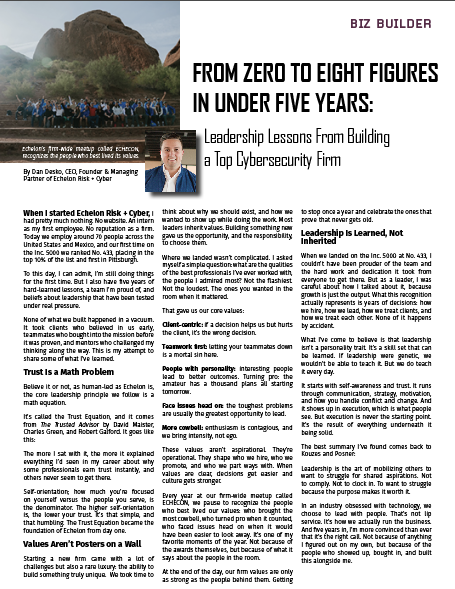 When I started Echelon Risk + Cyber, I had pretty much nothing. No website. An intern as my first employee. No reputation as a firm. Today we employ around 70 people across the United States and Mexico, and our first time on the Inc. 5000 we ranked No. 433, placing in the top 10% of the list and first in Pittsburgh.
To this day, I can admit, I’m still doing things for the first time. But I also have five years of hard-learned lessons, a team I’m proud of, and beliefs about leadership that have been tested under real pressure.
None of what we built happened in a vacuum. It took clients who believed in us early, teammates who bought into the mission before it was proven, and mentors who challenged my thinking along the way. This is my attempt to share some of what I’ve learned.
Trust Is a Math Problem
Believe it or not, as human-led as Echelon is, the core leadership principle we follow is a math equation.
It’s called the Trust Equation, and it comes from The Trusted Advisor by David Maister, Charles Green, and Robert Galford. It goes like this:
The more I sat with it, the more it explained everything I’d seen in my career about why some professionals earn trust instantly, and others never seem to get there.
Self-orientation; how much you’re focused on yourself versus the people you serve, is the denominator. The higher self-orientation is, the lower your trust. It’s that simple, and that humbling. The Trust Equation became the foundation of Echelon from day one.
Values Aren’t Posters on a Wall
Starting a new firm came with a lot of challenges but also a rare luxury: the ability to build something truly unique. We took time to think about why we should exist, and how we wanted to show up while doing the work. Most leaders inherit values. Building something new gave us the opportunity, and the responsibility, to choose them.
Where we landed wasn’t complicated. I asked myself a simple question: what are the qualities of the best professionals I’ve ever worked with, the people I admired most? Not the flashiest. Not the loudest. The ones you wanted in the room when it mattered.
That gave us our core values:
Client-centric: if a decision helps us but hurts the client, it’s the wrong decision.
Teamwork first: letting your teammates down is a mortal sin here.
People with personality: interesting people lead to better outcomes. Turning pro: the amateur has a thousand plans all starting tomorrow.
Face issues head on: the toughest problems are usually the greatest opportunity to lead.
More cowbell: enthusiasm is contagious, and we bring intensity, not ego.
These values aren’t aspirational. They’re operational. They shape who we hire, who we promote, and who we part ways with. When values are clear, decisions get easier and culture gets stronger.
Every year at our firm-wide meetup called ECHECON, we pause to recognize the people who best lived our values: who brought the most cowbell, who turned pro when it counted, who faced issues head on when it would have been easier to look away. It’s one of my favorite moments of the year. Not because of the awards themselves, but because of what it says about the people in the room.
At the end of the day, our firm values are only as strong as the people behind them. Getting to stop once a year and celebrate the ones that prove that never gets old.
Leadership Is Learned, Not Inherited
When we landed on the Inc. 5000 at No. 433, I couldn’t have been prouder of the team and the hard work and dedication it took from everyone to get there. But as a leader, I was careful about how I talked about it, because growth is just the output. What this recognition actually represents is years of decisions: how we hire, how we lead, how we treat clients, and how we treat each other. None of it happens by accident.
What I’ve come to believe is that leadership isn’t a personality trait. It’s a skill set that can be learned. If leadership were genetic, we wouldn’t be able to teach it. But we do teach it every day.
It starts with self-awareness and trust. It runs through communication, strategy, motivation, and how you handle conflict and change. And it shows up in execution, which is what people see. But execution is never the starting point. It’s the result of everything underneath it being solid.
The best summary I’ve found comes back to Kouzes and Posner:
Leadership is the art of mobilizing others to want to struggle for shared aspirations. Not to comply. Not to clock in. To want to struggle because the purpose makes it worth it.
In an industry obsessed with technology, we choose to lead with people. That’s not lip service. It’s how we actually run the business. And five years in, I’m more convinced than ever that it’s the right call. Not because of anything I figured out on my own, but because of the people who showed up, bought in, and built this alongside me.