Understanding Equity Compensation - The Foundation Every Executive Needs
By Christine Robinette, Chief Executive Officer, Fragasso Financial Advisors crobinette@fragassoadvisors.com
Equity compensation is a form of incentive-based pay that allows companies to align employee interests with long-term company performance through ownership-based awards.
Today, equity compensation has expanded well beyond the executive suite and is widely used by both public and private companies to reward and retain key contributors through multi-year vesting schedules. In most cases, realizing the full value of these awards requires continued employment or the achievement of defined performance goals.
Equity compensation is a non-cash component of total compensation and, for many professionals, becomes one of the most significant elements of their overall financial picture influencing wealth accumulation, career decisions, and long-term planning. Yet equity compensation can feel complex, particularly with vesting schedules, tax rules, trading restrictions, and market volatility. With so much at stake, it is important to understand how these incentives work and the choices available to you.
Before exploring the types of equity compensation, it helps to understand the core terms that govern how these plans function.
CORE TERMS
· Grant Date: The official date your company awards stock or stock options to you.
· Strike / Exercise Price: The fixed price you pay to purchase shares when exercising stock options.
· Vesting: Earning the right to receive or exercise your equity award over time or based on performance goals.
· Vesting Schedule: The timeline that determines when your shares or options become available to you.
· Exercise: The act of purchasing shares using your stock options.
· Expiration Date: The deadline for which stock options must be exercised before they expire and are forfeited.
· Holding Period (ISOs): The length of time shares must be held to qualify for favorable tax treatment.
· Liquidity & Trading Restrictions: Limits on when and how you can sell shares due to trading windows, blackout periods, insider-trading rules, or the absence of a public market.
· Concentration Risk: Equity awards often tie wealth to a single company’s stock, creating significant single-stock exposure, making diversification planning essential.
With this foundation established, we can now explore the most common forms of equity compensation including stock options and stock grants and how they work in practice.
Employee Stock Options (ESOs)
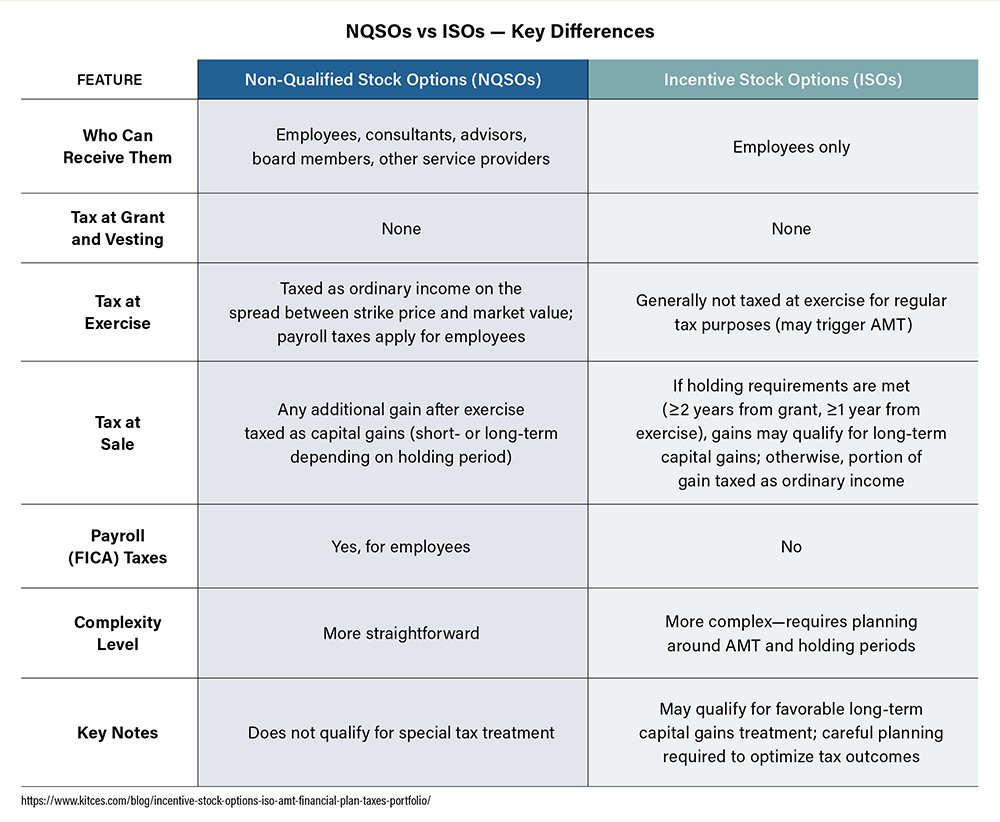
ESOs give you the right, but not the obligation, to purchase company shares at a fixed price for a defined period. The two primary types differ in who can receive them and how they are taxed.
Non-Qualified Stock Options (NQSOs)
· Can be granted to employees and other service providers
· No special tax treatment
· Taxes due at exercise, with the spread taxed as ordinary income
· Additional gains taxed as capital gains.
Incentive Stock Options (ISOs)
· Available only to employees
· May qualify for favorable long-term capital gains treatment
· No regular income tax due at exercise (though AMT may apply)
· Holding period rules determine final tax treatment
Stock Grants
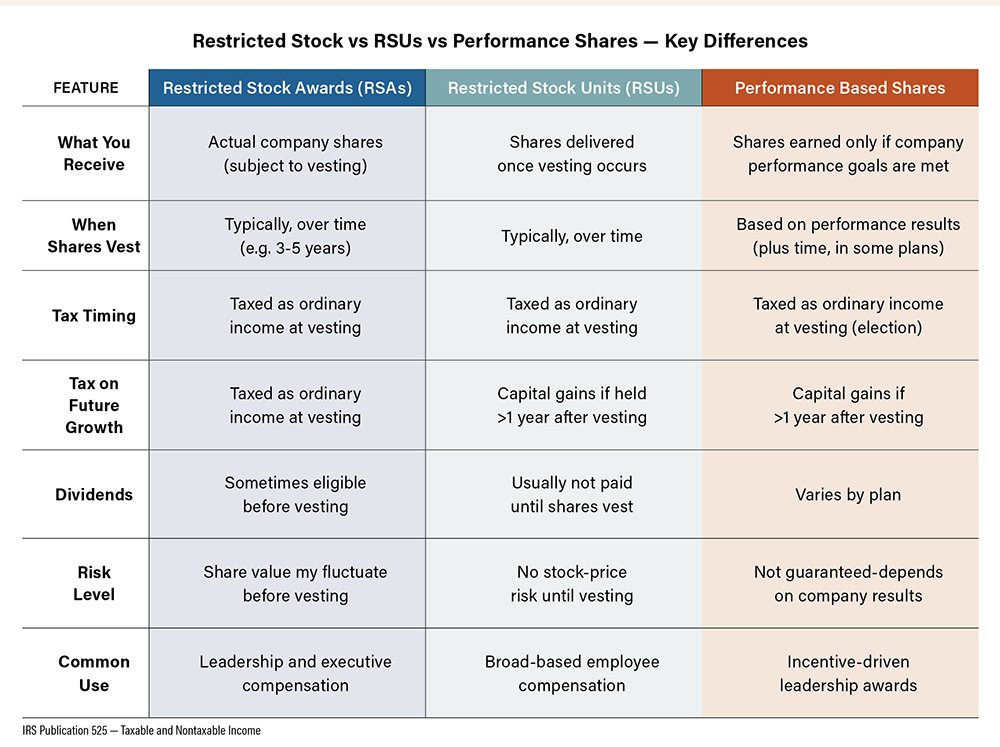
Stock grants are a form of equity compensation where employees receive company shares without needing to purchase them. Shares are typically subject to vesting, allowing employees to earn ownership over time and aligning their interests with long-term company success. While grant structures differ in how and when shares are delivered, all serve to convert equity compensation into ownership. The most common types of stock grants are outlined below.
Restricted Stock Awards (RSAs) – Actual company shares issued at grant and subject to vesting. Restricted Stock Units (RSUs) – Shares delivered upon vesting. Performance-Based Shares – Shares earned only if defined performance goals are achieved.
This chart helps to summarize the key differences between the 3 types of Stock grants.
For many executives, equity compensation becomes the largest driver of long-term wealth but also one of the most complex financial planning challenges. Vesting does not always equal liquidity, tax outcomes depend heavily on timing, and concentrated stock positions introduce additional risk. Thoughtful planning around exercise timing, tax strategy, diversification, and liquidity can meaningfully impact after-tax outcomes.
With that foundation in place, the natural next question becomes: how can thoughtful planning turn equity compensation into a powerful driver of wealth?
The answer begins with the questions we hear most often from clients navigating their equity awards, when to exercise or sell, how taxes come into play, what happens if they change employers, and how equity fits into the bigger picture of their financial life.
By approaching equity compensation with a clear strategy, employees can move beyond simply receiving awards and begin converting them into long-term wealth.
Source: IRS Publication 525 — Taxable and Nontaxable Income
For more information, contact Christine Robinette, Chief Executive Officer, Fragasso Financial Advisors at crobinette@fragassoadvisors.com
Investment advice offered by investment advisor representatives through Fragasso Financial Advisors, a registered investment advisor.