Gecko Robotics Talks About Building Tech That Works in the Real World
 Gecko Robotics founder Jake Loosararian does not talk about entrepreneurship in the language of quick exits, easy wins or technology for technology’s sake.
His philosophy is much more physical.
Find a hard problem. Get close to it. Understand the people living with it. Build something that works in the real world. Then keep expanding the amount of the problem you can solve.
That philosophy has taken Gecko from a wall-climbing robot developed by Loosararian while studying electrical engineering at Grove City College to a Pittsburgh-based technology company tackling some of the toughest challenges facing power plants, refineries, shipyards, manufacturing facilities and other critical infrastructure.
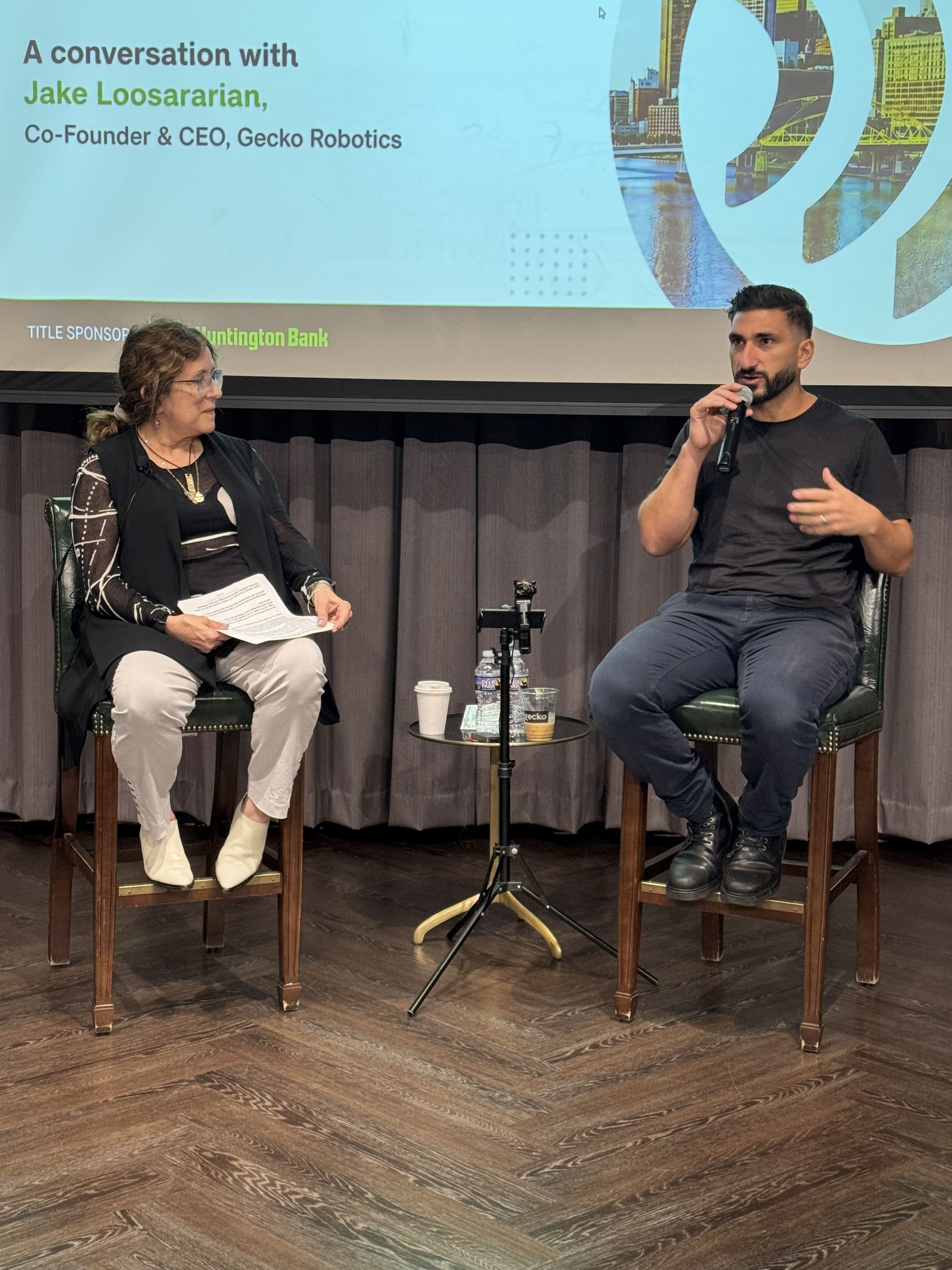
During a Huntington Bank Breakfast Briefing hosted by the Pittsburgh Technology Council, Council President and CEO Audrey Russo traced that journey with Loosararian, including the decisions and convictions that shaped Gecko along the way.
The company’s origin came from a visit Loosararian made to a Pennsylvania power plant in 2012. He saw workers conducting dangerous inspections inside enormous boilers, searching manually for defects that could lead to catastrophic failures. One worker who had performed the job had fallen and died.
Loosararian returned to campus determined to create a safer way.
He built a wall-climbing robot capable of inspecting the equipment while allowing a worker to remain safely below. But the larger insight was bigger than the robot itself: enormous parts of the industrial economy were operating with aging infrastructure and outdated technology.
“That kind of created this idea in my head” of building technology for people largely forgotten by the technology industry, Loosararian explained.
Why Pittsburgh?
 Loosararian eventually spent time in Silicon Valley, where an investor offered him $2 million on the condition that Gecko remain in California and develop its technology in a lab before taking it to customers.
He walked away.
For Loosararian, building physical technology apart from real customers was exactly backward. Robotics, AI and industrial systems improve through real-world deployment and real-world data. Pittsburgh offered something Silicon Valley could not easily replicate: proximity to the problems Gecko wanted to solve.
Importantly, he does not frame Gecko’s Pittsburgh headquarters as civic loyalty.
“I only wanna be in Pittsburgh if it’s the best place to build the company,” he said.
He believes it is, pointing to three advantages: proximity to industrial problems, political relevance and untapped potential.
His ambition extends beyond Gecko. Loosararian wants Pittsburgh to create companies that become the centers of gravity of their industries, rather than regional offices, research outposts or acquisition targets. Successful companies create experienced employees, meaningful equity, new founders and ultimately a flywheel of additional startups.
Instead of building companies to be consumed, he wants Pittsburgh companies to become the consumers and consolidators.
The Danger of SBIR Dependency
Loosararian was equally provocative when discussing government Small Business Innovation Research grants.
His warning is not that SBIR grants never work. It is that entrepreneurs can mistake a grant for evidence that they have found a genuine customer.
“You think there’s a customer, and you think you have a customer, and you build a company around an idea, but that idea is a grant,” he said.
Companies can spend enormous amounts of time writing proposals, completing research phases and chasing subsequent awards while convincing themselves that continued grant funding proves market demand.
Too often, Loosararian argued, it does not.
He described a potential “graveyard” of talented people spending years pursuing projects that never develop into scalable businesses. Gecko took another path. It first demonstrated commercial traction and later worked with government customers, including the U.S. Navy, around problems where the technology had already shown it could deliver measurable results.
The takeaway is not necessarily “never take an SBIR.” It is more demanding: never allow grant funding to become a substitute for customer validation.
Build Outcomes, Not Point Solutions
Perhaps Loosararian’s most important business-building idea is that entrepreneurs should resist defining themselves by the technology they make.
A robot is a point solution. AI is a tool.
The bigger opportunity is understanding the business outcome those tools can transform.
Loosararian believes robotics companies historically created enormous value while capturing too little of it. Rather than simply selling a machine and walking away, technology companies should ask how the machine changes the entire process around it.
That is increasingly Gecko’s direction. Robots gather information. Data feeds its Cantilever platform. That intelligence can guide maintenance, manufacturing, welding and eventually additional physical work.
The ambition is not merely to make better robots.
It is to reinvent how industrial work gets done.
Loosararian applies a similarly demanding standard to people. When hiring, he looks closely at motivation, decision-making and especially toughness. Startups inevitably experience difficult periods, and he wants people who have demonstrated an ability to absorb setbacks, think deeply and remain committed when conditions deteriorate.
Taken together, his philosophy is remarkably consistent: get close to reality, distrust artificial signals, build around outcomes and surround yourself with people capable of enduring the difficult stretches.
That may be the clearest explanation for why Gecko continues to build in Pittsburgh.
The region gives Loosararian exactly what he believes technology companies need most: complicated industries, complicated problems and the opportunity to solve them in the real world.
I especially like the “grant is not a customer” takeaway. That could become a killer pull quote, sidebar or even a standalone follow-up piece for entrepreneurs.