Lordy, Lordy, Look Who's 40! PSC Powers Four Decades of Discovery
Todd Miller
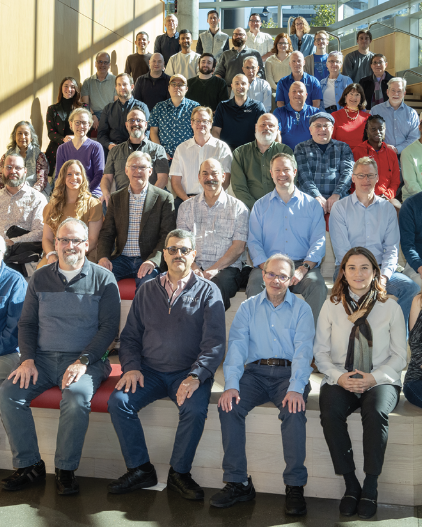 For 40 years, the Pittsburgh Supercomputing Center (PSC) has quietly powered some of the country’s most advanced scientific research from its Oakland headquarters. Long before the public became concerned about artificial intelligence (AI), and before the term cloud computing entered mainstream vocabulary, PSC helped researchers solve problems too large, expensive, or complex for conventional computing systems.
Today, as AI and data-intensive research reshape industries ranging from healthcare to manufacturing, PSC is receiving a level of public attention it has rarely attracted in the past. That growing visibility reflects both the increasing importance of high-performance computing and Pittsburgh’s emergence as a center for AI, robotics, and advanced technologies.
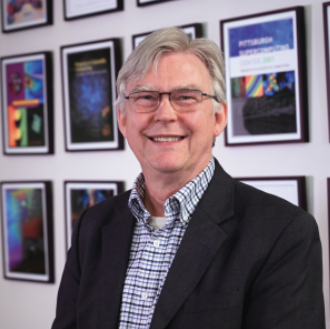
Founded in 1986 as a joint initiative between Carnegie Mellon University and the University of Pittsburgh, PSC is one of the nation’s original supercomputing centers funded by the National Science Foundation (NSF). According to Barr von Oehsen, Ph.D., Executive Director of PSC and vice chancellor for research at Pitt, the Center emerged from a growing realization that many scientific questions could not be answered efficiently through traditional experimentation.
“Scientists realized there are physical phenomena you simply can’t measure directly in a lab,” says von Oehsen. “If you want to understand what happens inside a nuclear reactor, for example, you can’t just step inside and run experiments repeatedly. Simulation became a way to reduce time, cost, and risk.”
The concept also carries enormous value for industrial research. In fields such as materials science and polymer engineering, repeated testing and manufacturing changes are prohibitively expensive. Supercomputing allows researchers to model processes digitally before committing resources to real-world production.
 PSC became one of the first national supercomputing centers capable of supporting that type of advanced computational work at scale. At the time, supercomputers cost tens of millions of dollars and were beyond the reach of most universities.
“Today’s smartphones have more computing power than those early systems,” says von Oehsen, “but in 1986, having access to that capability was transformational.”
Reinventing Supercomputing
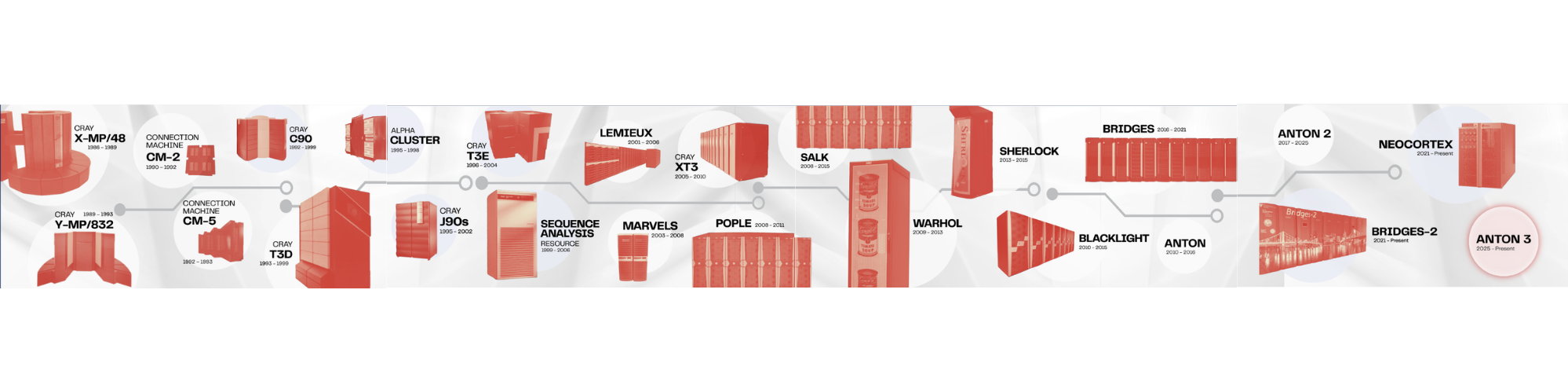
Over the past 40 years, PSC has helped establish Pittsburgh as a credible player in advanced computing despite competition from larger institutions across the nation. As supercomputing evolved from specialized standalone machines into large parallel systems built from commodity hardware, PSC adapted by embracing technologies such as Beowulf clusters.
“We went from being one of the only places with supercomputers to becoming a partner that could scale beyond what most universities could do themselves,” says von Oehsen.
Today, PSC supports thousands of researchers nationwide in disciplines ranging from climate science and biomedical research to the humanities and AI.
Some of PSC’s most interesting projects have crossed boundaries between science and culture. One initiative used computational modeling to help develop carbon-fiber string instruments after traditional tonewoods became increasingly scarce. Yo-Yo Ma played the resulting carbon-fiber cello.
Biomedical research has become another key focus. Thanks to funding from the National Institutes of Health (NIH), PSC supports projects such as the Human BioMolecular Atlas Program (HuBMAP), which seeks to map the cellular composition of the human body in unmatched detail.
AI and Research
PSC also played a meaningful role during the COVID-19 pandemic, when researchers used its systems to model the virus and accelerate vaccine-related research.
“During COVID, we made our resources available to help researchers model the virus much more quickly,” von Oehsen recalls. “That directly helped speed up scientific understanding and vaccine development.”
AI has become one of PSC’s fastest-growing areas of activity. Although AI research has existed for decades, the public release of ChatGPT in late 2022 dramatically increased awareness of the computing infrastructure required to train and operate large-scale AI systems.
“ChatGPT changed everything,” says von Oehsen. “Suddenly, everybody understood that these technologies require enormous computing resources. In many ways, it’s pushing PSC back toward its original role as a national resource center because many universities and other kinds of organizations can’t support these systems on their own.”
PSC has supported AI-related research for years, including Carnegie Mellon’s Never-Ending Language Learner (NELL) project and other machine-learning initiatives. More recently, PSC’s Neocortex AI system became part of the National AI Research Resource (NAIRR) pilot program, further positioning Pittsburgh within the emerging national AI ecosystem. Shortly afterward, PSC’s flagship Bridges-2 system also joined the NAIRR initiative after receiving a supplement from NSF to add more AI capabilities.
The rapid expansion of AI workloads is also renewing PSC’s focus on providing the scientific community with the most powerful, late-model systems as technology changes. Modern AI systems rely heavily on graphics processing units (GPUs), but both AI and other high performance computing still need ample “traditional” central processing units (CPUs). Such heterogeneous systems consume enormous amounts of electricity and generate significant heat. Many university data centers lack the power and cooling infrastructure necessary to support these systems at scale.
PSC is also exploring edge computing, which moves computational resources closer to where data is generated, whether in laboratories, hospitals, manufacturing facilities, or commercial farms.
Growing the Workforce
PSC’s role increasingly extends beyond research computing into workforce development and regional economic growth. The Center works with universities, community colleges, statewide educational organizations, and even high and middle schools, to help students gain familiarity with AI and advanced computing tools.
That educational mission has become increasingly important as AI technologies begin reshaping large segments of the workforce. Through programs such as Adapt PA, PSC is helping prepare both traditional college students and technical workers for an economy increasingly influenced by AI and digital infrastructure.
“We want to future-proof jobs in Pennsylvania,” von Oehsen says, “because AI is affecting white-collar and blue-collar workers alike.”
He also believes that those workforce challenges are tied to a broader public misunderstanding about how advanced computing systems operate. “Most people interact with AI and digital services through phones and laptops without realizing the scale of infrastructure operating behind the scenes. Specifically, they are unaware that their requests are being processed by massive computing facilities capable of supporting millions of users simultaneously.”
As Pittsburgh continues to strengthen its position as a center for AI, robotics, life sciences, and advanced manufacturing, PSC increasingly represents both the region’s technological legacy and an important part of its future.