Pittsburgh Robot Takes a Bite Out of a Pothole
The question sounded almost too simple: Can a computer fill a pothole?
Last Friday at the IronGate Technology Center in Pittsburgh, Silly Surfacing provided an answer.
Yes.
In front of attendees gathered for the technology’s first public demonstration, Silly Surfacing’s prototype robot successfully scanned, analyzed and filled a real pothole, marking a major milestone for a Pittsburgh-developed technology aimed at making road repair safer, faster and eventually autonomous.
For Silly Surfacing CEO Keith Giuliani, the demonstration represented the culmination of work with Innovation Works’ Robotics Factory and the University of Pittsburgh Swanson School of Engineering.
“Today is a very proud day for us,” Giuliani told attendees before the demonstration, describing the goal simply: show how a robot can go in and fill a pothole.
 The problem the company is attacking is anything but small.
During introductory remarks, the Pitt engineering team noted that potholes account for billions of dollars in vehicle damage each year while municipalities and transportation agencies continue pouring significant resources into road maintenance. Pittsburgh, with its freeze-thaw cycles and famously battle-scarred streets, provides no shortage of real-world test cases.
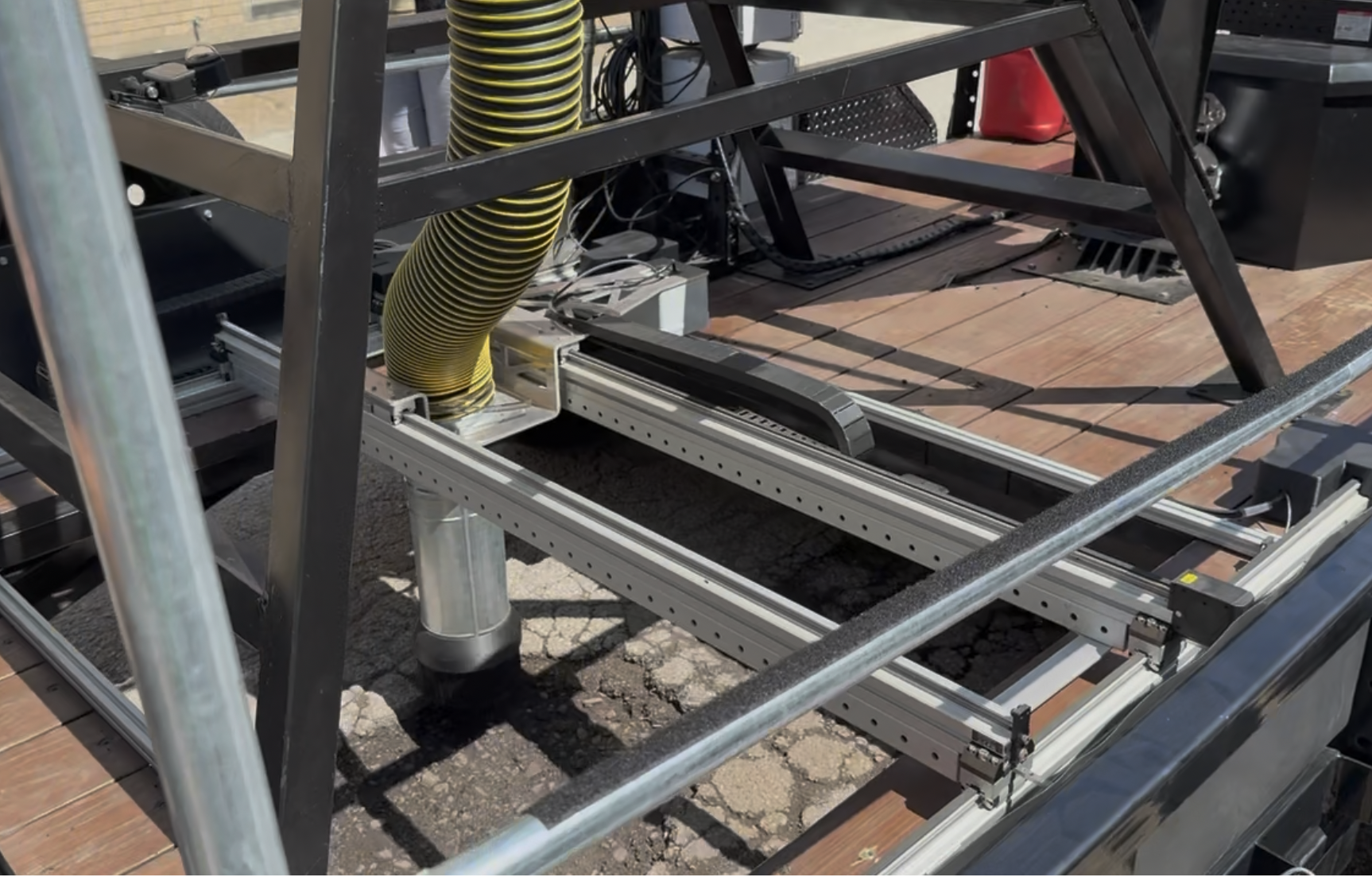
Traditional cold-patch repair can require a three-person crew to travel to a site, control traffic, leave the vehicle, manually fill the hole and tamp the material. Silly Surfacing’s vision is dramatically different: one worker inside one vehicle overseeing an automated system that senses, cleans, fills and tamps a pothole, potentially in less than a minute.
The prototype demonstrated Friday represents what the Pitt team called “pothole robot generation one.”
Silly Surfacing participated in Innovation Works’ Robotics Factory accelerator, which provided funding and resources to help scale the concept. The company then worked with Pitt’s IDEA Lab in the Swanson School of Engineering to build the trailer-mounted system. About 15 Pitt student engineering interns contributed to the project.
At the heart of the robot is a time-of-flight camera that creates a 3D image of the pothole. Software determines the hole’s dimensions, contour and volume, calculates how much asphalt is needed and creates a tool path directing the machine where to dispense material.
Friday’s successful fill represented the third major development phase for the project: demonstrating an automated pothole repair at full scale.
There is still plenty of engineering ahead before fleets of robotic pothole fillers begin roaming Pittsburgh streets. But for one pothole on one August afternoon, the technology worked.
And for Silly Surfacing, that was exactly the point. Giuliani noted that Sill Surfacing is now ready to raise $5 million to ready the technology for market deployment.