Why Data Centers and Energy Projects Are Rewriting the Region’s Economic Future
By Tim Hayes
 You hear “DC,” and what leaps to mind? The nation’s capital? A movie starring Superman or Batman? Heaven forbid, the Dallas Cowboys? Well, another option for that acronym has emerged, with every likelihood of soon becoming the one that people think of first – data centers.
Large clusters of buildings housing enormous computing and digital storage capabilities, consuming electricity at tremendous levels to keep up with the processing requirements created by the soaring expansion of artificial intelligence and the rise in electrification of businesses, products, and vehicles – data centers have become a ubiquitous presence in American society. This phenomenon has taken hold in the Pittsburgh region, as well, with data centers planned for Springdale Borough in Allegheny County, Homer City in Indiana County, and Beaver Valley in Beaver County.
Questions of the impact on neighboring communities, any resulting economic development benefits surround the growth of data centers. But perhaps the most pressing question revolves around the matter of: From where will the additional sources of electrical generation come? Where will they be located? What will they cost? And who will be picking up the tab? Here, answers to those questions have been sought from a number of experts.
Data Center Coalition: The Big Picture
While discussion of data centers has expanded as more proposed sites advance toward development, the fact remains that these facilities have been around for decades. It’s no longer a question of whether you want to get on this particular train – you’ve been riding it for years.
“Data centers are at the heart of everything we do every day,” said Dan Diorio, Vice President of State Policy with the Data Center Coalition. “We’re going to create twice as much data in the next 5 years as we did in the previous 10, and so the industry is building out to meet that demand. All indications are that we’re behind meeting that data demand curve right now.”
Currently, demand is outpacing supply regarding the amount and reliability of electricity generation that data centers need, as well. Bringing that situation into better balance is key. While some forecasters speculate that demand for electricity will rise in parallel with the rise in data demand, cooler heads see electricity demand increasing by around 2-3% per year on the PJM Interconnection grid into the early 2030s. Still a sizeable rise that must be addressed.
“We’ve just come out of about two decades of pretty flat electricity-load growth, and now we know it is on the rise for a variety of factors intricately tied to economic development – digital infrastructure, advanced manufacturing, electrification of vehicles, homes, buildings, and industry, and emerging hydrogen production,” Diorio explained. “The data center industry is really leaning in as a stakeholder to address short-term and long-term concerns.”
Solutions include behind-the-meter electricity generation created by the data center itself on-site, and co-location opportunities. Added Diorio, “The industry is committed to paying our full cost-of-service for electricity. We’re working with the PUC, with PJM, with the legislators to ensure that costs are allocated appropriately and that ratepayers are protected.”
After the surge in construction jobs to build a data center, the economic benefits to regional economies continue, albeit perhaps in less visible ways. “If you go to any data center parking lot, you’ll find it full of local electricians, local trades working on that facility just about every day, swapping components out, maintaining it, ensuring that it’s running at an optimal level at all times,” he said. “Data centers, on the whole, are going to have high-wage jobs, but they’re not going to have as significant a draw on local infrastructure as other types of development might.”
In Loudon County, Virginia, for example, Diorio said studies show that for every $1 that data center industry utilizes in public services, it gives $26 back in tax revenue to the community. In fact, that county lowered residential property tax and vehicle tax rates in 2025, with the County Executive stating, “This is directly attributable to data center revenue.”
Diorio cites a data center In Loudon County, Virginia, that has determined for every $1 that data center utilizes in public services, it gives $26 back in tax revenue to the community. In fact, that county lowered residential property tax and vehicle tax rates in 2025, with the County Executive stating, “This is directly attributable to data center revenue. This is why we’re lowering these.”
Homer City: $10 Billion Investment
 The tall cooling towers of the former Homer City generating station had been part of the Indiana County landscape for decades. But the ground there has shifted. A new gas-fired power generating station will occupy the site, helping to power a next generation energy and digital infrastructure campus.
“Homer City is in an excellent position because the fundamentals are already here – we have an existing site built around power generation, with existing high-voltage connections, and a substation footprint designed for utility-scale output,” said Corey Hessen, CEO of Homer City Redevelopment LLC. “We are fortunate to have operated in this community for more than 60 years, and the partnerships and relationships created over that time are priceless.”
The tremendous increase of activity to build the power plant and adjoining campus will provide a major boost to the local economy, he said, but that won’t be the end of it.
“It’s not just the good-paying jobs at the plant. It’s also the jobs the local investment will attract,” Hessen said. “The community will experience a surge in investment that it hasn’t seen in a long time. We’re working with local leaders, our colleagues in the regional trades and labor unions, and others to make sure all we do meets and exceeds the expectations of the communities that we serve – safety, quality of life, and opportunity.”
In fact, the project is expected to create more than 10,000 direct on-site construction-related jobs along with approximately 1,000 total direct and indirect permanent high-paying positions in technology, operations, and energy infrastructure.
The generating station is designed to deliver approximately 4.4 gigawatts of highly efficient generating capacity, enough to support the digital infrastructure campus, while also providing significant power for the grid. It is being built in phases, so that capacity can be brought online as soon as it’s ready and customers need it. The project will advance over four stages:
- Finalizing engineering and permitting.
- Completing major site work and procurement of all necessary equipment.
- Completing grid and fuel infrastructure work.
- Commissioning and ramp-up, bringing generation online as it’s ready and then steadily scaling the project to its full capability.
Many of these stages are complete, while others are still in progress. The target to deliver first power arrives in early 2028, with additional capacity coming online in subsequent phases.
The project also features some innovative advances in power generation, including new turbines, the latest in turbine and plant controls, real-time monitoring, and predictive maintenance systems to improve reliability and efficiency. The power quality and dispatch capabilities will allow the facility to operate efficiently and be responsive to changing system conditions.
“Homer City Generation demonstrates how to turn legacy energy strength into next-generation leadership in efficient, sustainable power generation,” Hessen said. “It provides a national model for how to safely deliver reliable, utility-scale power to feed the country’s evolving and ever-increasing need for electrical power. Indiana County is my home now, too, and I have a personal stake in helping it thrive – we all do – and that is very much top of mind.”
Springdale: Becoming a Neighbor
 How does a 565,000 square foot hyperscale AI data center with a 200,000 square foot state-of-the-art cooling facility, on a 47-acre site of a former coal-burning power plant, set to draw 180 megawatts of power, become a welcome neighbor sitting mere blocks from the house where famous environmentalist Rachel Carson once called home? For Allegheny Property Company, it has meant lots of open communication, diligent listening, and a clear determination to state its case of bringing jobs, growth, and a windfall of local tax revenue.
Allegheny Property purchased the site, where the Cheswick Generating Station once operated, in November 2025 for $14.3 million, and Springdale Borough Council approved a Conditional Use Permit in December 2025, amid some vocal opposition from residents. Some of the primary benefits to flow from the new data center, as cited by Allegheny Property, include:
- Creation of 80-100 permanent, well-paying jobs that do not require advanced degrees, but more a need for people with strong mechanical skills, able to build things and maintain complex systems.
- Tax implications for Springdale Borough, Allegheny Valley School District, and Allegheny County. Currently, the dormant site generates $66,000 in total real estate taxes annually. Once complete, the new data center is estimated to generate $2.56 million in annual real estate taxes, with approximately $650,000 going directly to Springdale Borough.
“We recognize that this process has been challenging and that not everyone in the community supports this project,” said Allegheny Property spokesperson Brian Regli. “Our hope is that over time, as we deliver on our commitments – including these specific tax revenue numbers – the community will see the benefits we’re describing become reality.”
Addressing specifically stated community concerns, the project owner offered these responses:
Noise – Comprehensive acoustic studies have been completed, so that all local noise standards are met and exceeded. Additional mitigation measures will be taken as needed. The Conditional Use Permit also contains specific enforceable noise parameters.
Visual Impact – A barrier of trees provides a natural screen for the site, and will be preserved. The seven-story facility will remain consistent with the site’s former industrial character.
Water – The facility will use a closed-loop water recycling system. After an initial draw from the municipal water source – about enough to fill an Olympic-size pool – that water will continuously recycle to provide cooling, rather than consuming fresh water on a continuous basis.
Air Quality – All parts of the facility will meet federal resource performance standards, and all state and county air quality requirements. It will be subject to ongoing state environmental compliance requirements, far beyond a one-time review.
Timeline for completion is as follows:
2026 – Preparing land development plans for review and approval from the Allegheny County Department of Economic Development’s Planning Division. Springdale Borough will have the opportunity to provide comment, to include public meetings.
2027 – Final permitting, to include environmental, grading, building, utility connections, stormwater management, and other regulatory clearances. Once these are secured, construction will begin and last 12 to 18 months.
2028 – Construction completed and systems testing begins, including hiring and training the permanent on-site workforce. Full operational capacity targeted for late 2028.
“The Commonwealth’s diverse energy portfolio provides the reliable, affordable power that hyperscale computing absolutely requires,” said Regli. “Western Pennsylvania’s industrial legacy has created a skilled workforce capable of building and operating complex technical facilities – exactly what we need. The region’s geographic location in the Northeast corridor provides low-latency connectivity to major population and business centers. These advantages are durable and substantial.
“We understand this is a big change for Springdale, and we know not everyone sees it the way we do. But we genuinely believe that years from now, this community will look back on this moment as pivotal – as the time when Springdale chose to evolve, to adapt, to lead.” Maybe that could even include Rachel.
Exus: Increasing Access to the Power Pool
 “We’ve been selling renewable energy to data centers for 20 years. Essentially, what has happened is that it’s been a matching process. You buy electricity, you put it into the grid. It’s like dumping a bottle of water into the ocean; it’s in there, but you don’t know where it is. That’s the way the grid is.” So explained Jim Spencer, CEO of Exus.
“In terms of queue positions and ability to come online, renewables are the quickest alternative to getting more power into the grid,” Spencer continued. “We are selling our power in Pennsylvania to a lot of companies matching it with their data center needs. We have begun to look at larger projects involving co-location. We might go in and if we have a site that’s suitable for a data center, it’s kind of like the old BYOB, but it’s BYOG: Bring Your Own Generation.”
Exus has been involved with both FERC and the Pennsylvania Public Utility Commission hearings concerning load management on the PJM Interconnection, including the question of whether data center operators should be mandated to bring their own generation in all cases.
Spencer noted, “Lots of data center developers are very viable companies, but they aren’t Google or Meta. You shouldn’t make it a barrier to entry to that sort of economic development, but where possible, bringing your own generation is a good path.”
Spencer said his company disagrees with the popular notion that the rapid increase in additional generation, as fueled by data center development, will inevitably spike other ratepayer energy bills. “For 20 years, we’ve had virtually no load growth in power usage because demand-side management has decreased power usage,” he said. “The growth in generation is really a good thing for the grid now because you’re going to have more users, more electrons, more people to spread that cost over, and with all of these increases, you’re going to have a much better grid because of all of this money that’s going into it.”
Vistra: Investment in the Public Grid
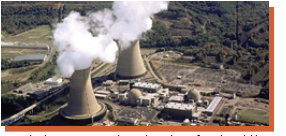 The private sector has begun ramping up to increase the power supply. Meta offers one of the most visible examples locally, investing in upgrades of two nuclear plants in Ohio – Perry and Davis-Besse – and one in Pennsylvania – Beaver Valley, at the former Shippingport plant site, to add a total of 433 megawatts of new nuclear-generated electricity to the grid.
“The real differentiator in this project is the fact that Meta is stepping up to bring new nuclear energy to the PJM grid, which serves all customers in the region,” said Stacey Dorè, Chief Strategy & Sustainability Officer at Vistra Corp, which owns the three plants. “To clarify, this 20-year agreement with Meta is not actually tied to any particular data center, but will add electrical capacity to the grid, benefiting all customers and grid reliability. Something that often gets lost in reaction to data centers is that it is actually helpful to residential and other customers when organizations like Meta invest in existing power plants and add new megawatts. That’s because those costs to both add capacity and invest in keeping the existing capacity around are not getting passed on to ratepayers, but ratepayers are going to benefit.”
Planned upgrades at Beaver Valley include use of enhanced fuel technology to improve plant efficiency, along with replacing some steam generators, and digitizing the control systems to improve operational efficiency.
Dorè said Vistra sees that PJM has the capacity to support the data center-driven load growth today. “Vistra has over 44 gigawatts of power generation nationwide, and much of that is natural gas. Our gas plants run at about 50% to 60% capacity factor on an annual basis, which means they have another 30% to 40% that they could run to soak up some of this demand, and they can run harder. On an average day, we have plenty of supply available in PJM to meet this load.” She added that with the growing need of more data centers, the available capacity does need to be addressed, starting now.
“Pennsylvania is a Democratic governor-led state, Ohio is a Republican governor-led state, but they have this common ground of an all-of-the-above energy policy and welcoming economic development,” she said. “To me, that is a really hopeful sign of how all sides can come together and support what a customer like Meta is bringing to the table.
“States like Pennsylvania want this data center load growth because it’s good for economic development, it’s good for local property taxes, it’s good, frankly, for U.S. leadership in AI,” Dorè concluded. “We’ve got to find a way to meet the moment and meet the demand, while at the same time make sure we’re keeping electricity affordable for the everyday consumer.”
Project Hummingbird Powers Greene County
 It’s tough to pass by an incomplete jigsaw puzzle, knowing how easy it would be to just fit those last pieces together to make a complete picture.
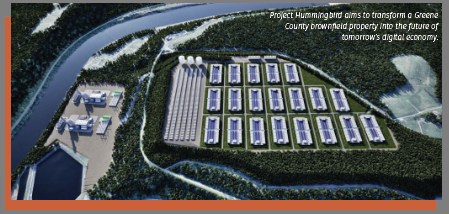
The same holds true on nearly 1,400 contiguous acres of brownfield in Greene County, with transmission infrastructure on-site from a retired electric-generation plant, water from the Monongahela River, good fiber connectivity, an available and eager workforce, and most of all, ample affordable natural gas to provide sufficient power – all to complete the picture of a major self-powered data center, which promises to create many hundreds of jobs over the next decade.
Dubbed Project Hummingbird, it can be found on the site of the former Robina coal processing site, which had been operated by Consol, now Core Natural Resources. International Electric Power, or IEP, is in the process of optioning the 1,368 acres for both power generation and AI development.
The project also features numerous regional connections – done quite intentionally, according to IEP’s Dave Spigelmyer. “We’re in partnership with Essential Utilities, the parent of People’s Gas and of Aqua, so we have the technical expertise. Our partner, JLL Real Estate in Pittsburgh, is helping us court a potential end user for the site. As we work with battery technology, we’ve already begun conversations with EOS, a Pittsburgh-based company. Regarding earth moving, we already have a contract with PJ Dick-Trumbull. It’s a really good Pittsburgh story.”
An economic analysis performed by the Allegheny Conference on Community Development has stated that if the site can generate between 900 megawatts and a gigawatt of power – the targeted level for the project – it would create about 1,500 jobs a year for up to six years during the initial development phase. If construction of a data center were to follow building a gas-fired power plant, the study said 1,500 new jobs could result annually for another six years. Those projections include direct, indirect, and induced jobs, translating into a significant economic impact.
“Greene County doesn’t usually gain jobs by the hundreds,” Spigelmyer said. “Having a project that can generate those kinds of jobs and help keep our kids at home would be fantastic. We’re working with the Greene County Career and Technology Center to develop curriculum to prepare students to work at that site. We need to prepare Greene County residents to win and get some of these jobs.
“Greene County looks at this as an opportunity to spur continued growth of their Marcellus Shale assets because that’s a big deal with the impact fee,” he added. “Since 2011, Greene County has cashed $162 million in checks. Project Hummingbird promises more to come.”
The jigsaw pieces are all there, Spigelmyer said. The task now is to fit them together.