State of the Economy Update: Key Insights from RSM Chief Economist Joe Brusuelas
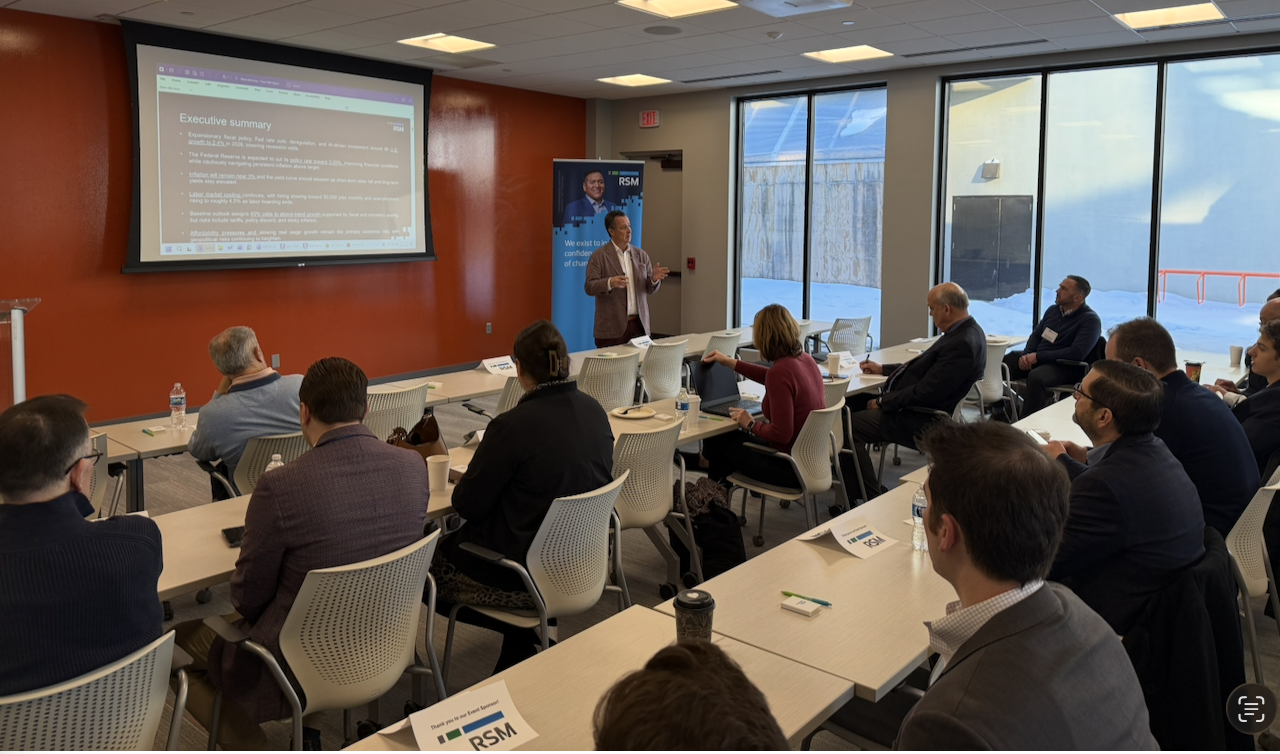 In his State of the Economy Update for Pittsburgh Technology Council members, RSM Chief Economist Joe Brusuelas offered a wide-ranging and candid assessment of the U.S. economic landscape, emphasizing resilience in headline growth alongside mounting structural and policy risks. Framed as an interactive discussion rather than a traditional lecture, his presentation explored how inflation, labor constraints, fiscal policy, and technological change are reshaping strategic decision-making for 2026 and beyond.
Brusuelas opened with a snapshot of economic performance, noting that U.S. GDP growth remains solid at approximately 2.3 to 2.4 percent, driven largely by upper-income consumers and technology-related spending. However, he cautioned that this strength masks a “K-shaped” economy, in which the top 40 percent of households account for more than 60 percent of consumption. While affluent households continue to spend, many middle- and working-class families face stagnation and affordability pressures. This imbalance, he argued, has become a defining feature of modern economic cycles.
Despite geopolitical tensions and policy uncertainty, Brusuelas estimated only a 20 percent probability of recession over the next year. Still, he highlighted vulnerabilities, particularly the heavy concentration of risk in the technology sector and equity markets. A sudden market correction, he warned, could quickly ripple through high-income households and slow broader growth.
On monetary policy, Brusuelas described a complex and politically charged environment. With uncertainty surrounding Federal Reserve leadership and ongoing scrutiny of Chairman Jerome Powell, markets currently expect limited rate cuts in the near term. Using his Taylor Rule model, Brusuelas argued that the “optimal” policy rate is closer to 4.75 percent, well above current levels, suggesting the economy is running hotter than fundamentals justify. Inflation, he said, appears to be settling near 3 percent, pointing to a prolonged period of above-target price growth.
Labor market dynamics were another central theme. Demographic aging, tight immigration policy, and pandemic-related exits have reduced labor supply to near zero growth. As a result, only about 50,000 new jobs per month are needed to maintain stability. While unemployment remains near full employment levels, job mobility has slowed, making it harder for workers to trade up for higher wages. Companies, he noted, are responding through increased capital investment and automation rather than expanded hiring.
Productivity has begun to improve, rising toward 2.5 percent after decades of stagnation. Brusuelas attributed this primarily to post-pandemic capital investment, with artificial intelligence expected to drive a more dramatic productivity boom in three to five years. At the same time, he cautioned that AI will disrupt professional services, consulting, and administrative roles, potentially displacing hundreds of thousands of workers.
Trade policy and tariffs remain a persistent risk. Effective tariff rates remain elevated, and Brusuelas warned that inventory drawdowns will soon expose firms to higher import costs. Combined with a weaker dollar, this could pressure margins and reignite inflation. He also expressed concern about diversification away from the dollar, driven by global unease over U.S. policy unpredictability.
Housing and affordability challenges featured prominently. With an estimated shortfall of three million homes, supply constraints continue to push prices and rents higher. Low-rate “forever mortgages” are not trapping homeowners, Brusuelas argued, but instead creating long-term wealth for those who secured them.
Looking ahead, Brusuelas projected moderate growth above trend, supported by fiscal stimulus, productivity gains, and financial sector strength. However, he emphasized that rising term premiums, persistent deficits, and politicization of monetary policy pose long-term risks.
Key Takeaways for Financial Leaders
-
Growth remains resilient, but increasingly dependent on high-income households and tech-sector performance.
-
Inflation is likely to remain near 3 percent, complicating long-term planning and capital allocation.
-
Labor shortages are structural, pushing firms toward automation and capital investment.
-
AI will reshape productivity and employment, with major impacts expected within five years.
-
Policy unpredictability and tariffs remain major sources of risk, especially for manufacturers and global firms.
-
Housing and affordability pressures will continue to influence workforce stability and compensation strategies.
Brusuelas concluded that while near-term prospects remain favorable, CFOs must prepare for a more volatile, uneven, and technologically driven economy, where strategic agility and disciplined risk management will be essential for long-term success.