Trust Scales Business; Control Does Not
By Nathan Wadding, Kindling Culture Agency
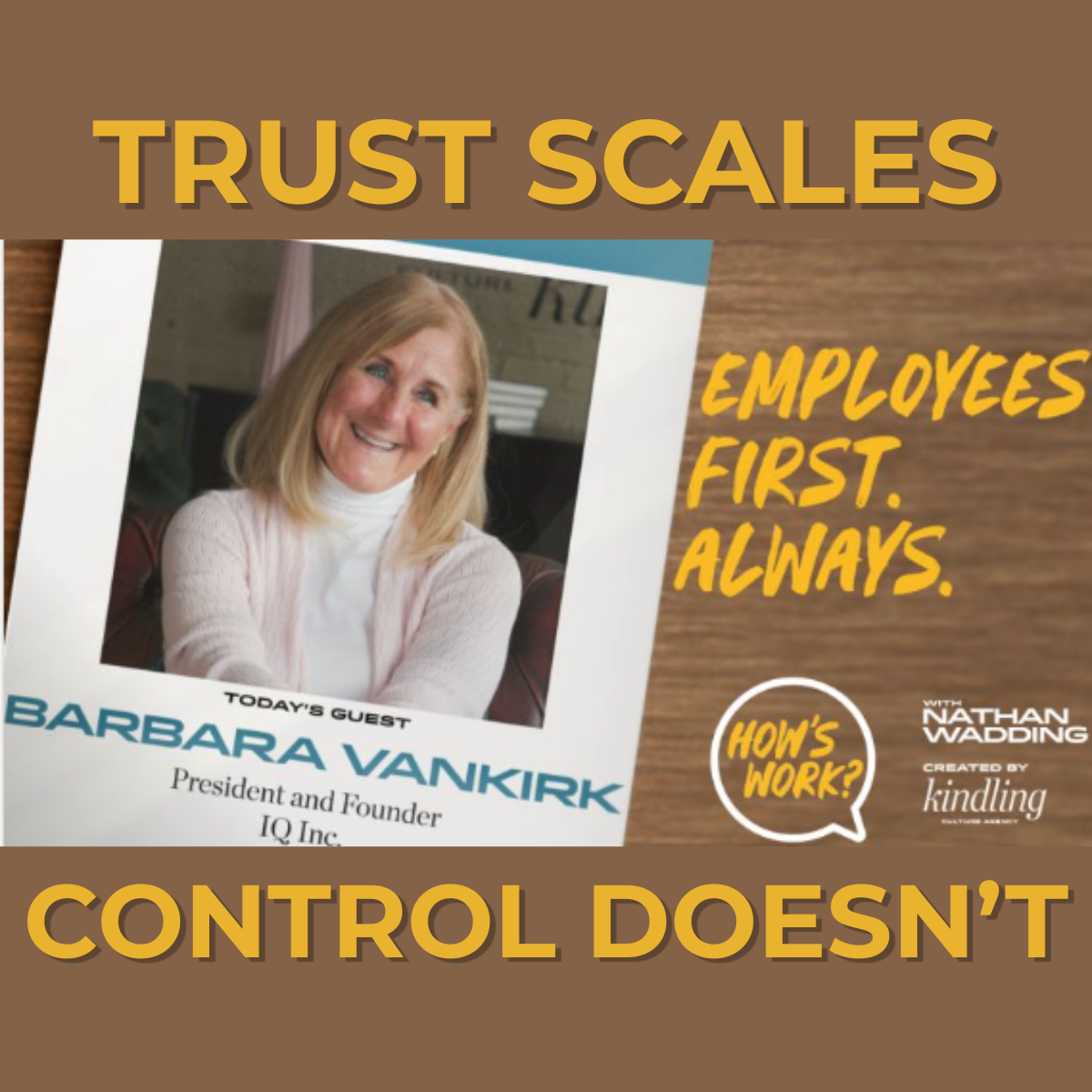 Barbara VanKirk built flexibility into her company before she had anyone to give it to.
It was 1994. She was working at a consulting firm, driving two hours a day in Pittsburgh traffic, and thinking about what she actually needed to do her best work. Not less work. Not more free time. Just the autonomy to decide, hour by hour, how to spend her own effort. She wrote a business plan for a flexible sales and recruiting territory that would let her work close to home instead of fighting the Squirrel Hill Tunnel twice a day. Her employer said no. She called her husband. He said, well, I guess you're just going to have to do it on your own. That became IQ Inc.
Flexibility wasn't a perk she added once she had employees to manage. It was the founding condition, built for her needs. "My value proposition was never what came home with me in a paycheck," she told me on my podcast, How's Work? "The value prop is: is my work valued? Am I valued as a person?" She knew what she needed. She had a hunch she wasn't the only one. Everything IQ became was built on that hunch that others needed the same kind of place to work as she did.
Most conversations about flexibility start elsewhere. They treat it as a perk, an economic trade, effort versus leisure, a workforce that will always choose comfort over output unless someone is watching. Under that framing, flexibility is a risk you manage through KPIs, badge swipes, and logged hours. It assumes people default to doing less unless supervised into doing more.
Barbara built the opposite way. Not because she rejected accountability, but because she'd already found the actual lever: trust scales better than control ever will. Control gets you compliance. People do the minimum while you're watching and coast when you're not. Trust gets you the other thing: people who care about the work because they believe you care about them. "People are never numbers," is how she thinks about it. I've come to believe the same thing doing this show: when people know you care, they care to invest.
She's never trusted the easy number, and it runs through how she's built IQ. Consulting work has always been billed by the hour; it's just been the easiest way to conduct business, and growing a company and developing a culture requires a change in mindset. Take her philosophy on how IQ develops and promotes people. "It shouldn't be based on time," she told me. "It's what have they accomplished, and how they've gotten there, and what leadership skills have they demonstrated." Time in a seat is the easiest thing to measure, so it's what most businesses default to on a spreadsheet. But easiest to measure isn't the same as true. Hours logged is a proxy for the thing you actually care about, and people aren't spreadsheet resources you can plug into an equation and solve for output.
None of this means presence stops mattering. Barbara still wants people in the office at IQ, three solid days a week, and she's specific about why. It's not oversight. It's that you can't read a room over Slack. "How many times have you been able to just walk down the hall and see somebody struggling, or somebody really excited?" she asked me. She worries that a generation raised entirely on remote work will lose the social instincts that only come from being around other humans, unscheduled and unscripted. Coming into the office isn't a form of control in her version. It's closer to: I want to see you, and I want you to see everyone else too. It's a support thing.
Flexibility done well isn't a free-for-all. Barbara has plenty of expectations for her people. They're just about what you contribute and how you show up for each other, not what hours you keep or where you sit.
So, three things worth taking back to your own team from this one:
- First, ask what you're actually optimizing for when you pick a metric. If it's hours or a KPI, ask whether you chose it because it's true or because it's easy to measure.
- Second, treat physical presence as a relationship, not surveillance.
- Third, remember that trust is a bet you make before you have proof, the same one Barbara made on herself in 1994, before anyone was there to prove her right. If you hire someone into your company, you're already betting on them. Bet on trust first.
Building culture is an art and a science. The trust, the instinct, the daily habits that make people feel valued- that's the art, and you can't manage it with a spreadsheet. But the results still show up in the numbers: quality, turnover, retention, how customers experience your company. Measure those. Just don't mistake the measurement for the thing that produced it.
There's a lot more in this conversation than fits here, including how Barbara evaluated whether to sell her company after thirty years of building it her way. Watch the full episode of How's Work? to hear the rest.
Nathan Wadding is the CEO and Founder of The Kindling Culture Agency, where he helps leaders gain clarity on their culture to design better places to work.