How Pittsburgh’s Tech Boom Rewired Its Skies
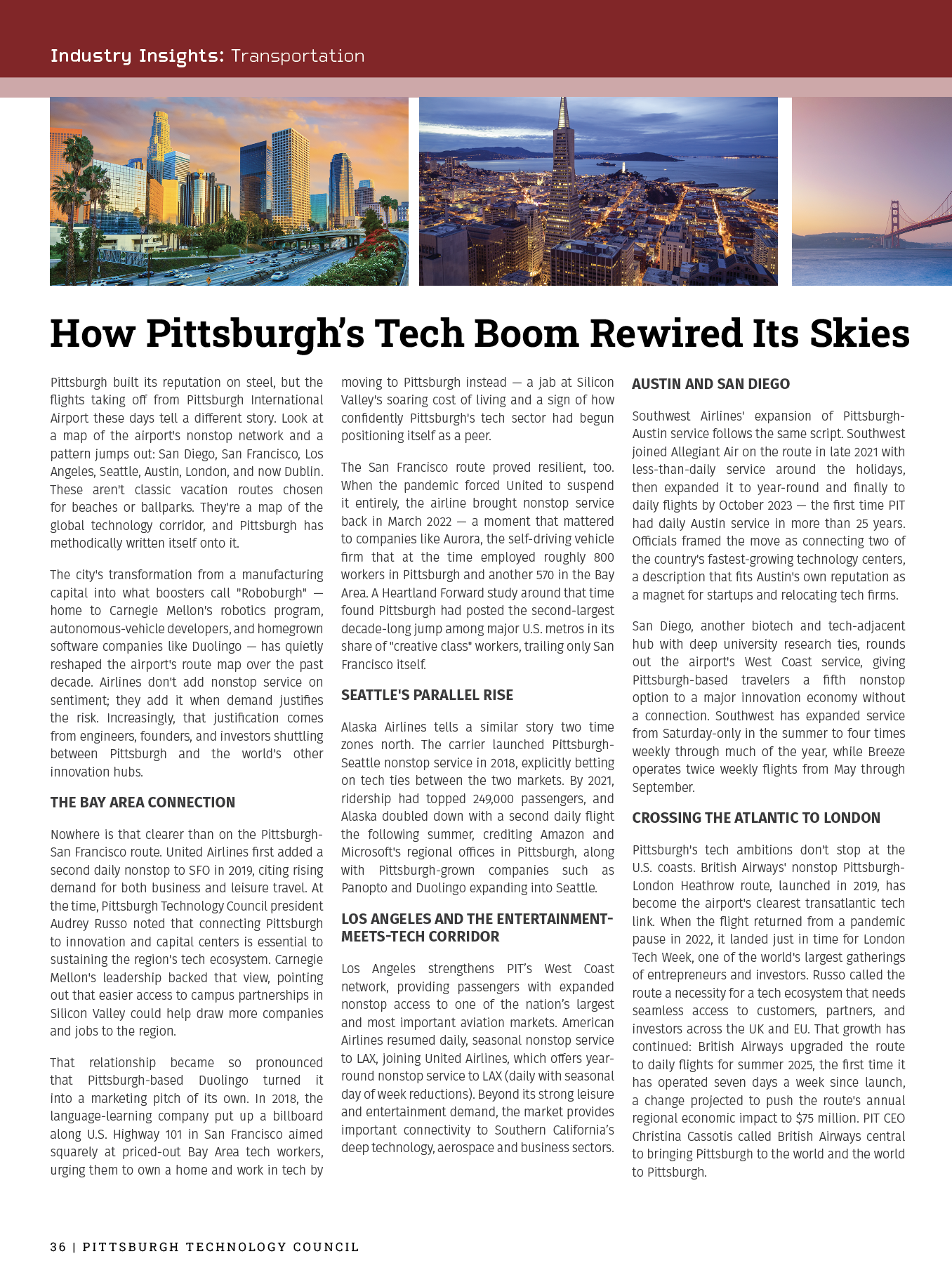 Pittsburgh built its reputation on steel, but the flights taking off from Pittsburgh International Airport these days tell a different story. Look at a map of the airport's nonstop network and a pattern jumps out: San Diego, San Francisco, Los Angeles, Seattle, Austin, London, and now Dublin. These aren't classic vacation routes chosen for beaches or ballparks. They're a map of the global technology corridor, and Pittsburgh has methodically written itself onto it.
The city's transformation from a manufacturing capital into what boosters call "Roboburgh" — home to Carnegie Mellon's robotics program, autonomous-vehicle developers, and homegrown software companies like Duolingo — has quietly reshaped the airport's route map over the past decade. Airlines don't add nonstop service on sentiment; they add it when demand justifies the risk. Increasingly, that justification comes from engineers, founders, and investors shuttling between Pittsburgh and the world's other innovation hubs.
The Bay Area connection
Nowhere is that clearer than on the Pittsburgh-San Francisco route. United Airlines first added a second daily nonstop to SFO in 2019, citing rising demand for both business and leisure travel. At the time, Pittsburgh Technology Council president Audrey Russo noted that connecting Pittsburgh to innovation and capital centers is essential to sustaining the region's tech ecosystem. Carnegie Mellon's leadership backed that view, pointing out that easier access to campus partnerships in Silicon Valley could help draw more companies and jobs to the region.
That relationship became so pronounced that Pittsburgh-based Duolingo turned it into a marketing pitch of its own. In 2018, the language-learning company put up a billboard along U.S. Highway 101 in San Francisco aimed squarely at priced-out Bay Area tech workers, urging them to own a home and work in tech by moving to Pittsburgh instead — a jab at Silicon Valley's soaring cost of living and a sign of how confidently Pittsburgh's tech sector had begun positioning itself as a peer.
The San Francisco route proved resilient, too. When the pandemic forced United to suspend it entirely, the airline brought nonstop service back in March 2022 — a moment that mattered to companies like Aurora, the self-driving vehicle firm that at the time employed roughly 800 workers in Pittsburgh and another 570 in the Bay Area. A Heartland Forward study around that time found Pittsburgh had posted the second-largest decade-long jump among major U.S. metros in its share of "creative class" workers, trailing only San Francisco itself.
Seattle's parallel rise
Alaska Airlines tells a similar story two time zones north. The carrier launched Pittsburgh-Seattle nonstop service in 2018, explicitly betting on tech ties between the two markets. By 2021, ridership had topped 249,000 passengers, and Alaska doubled down with a second daily flight the following summer, crediting Amazon and Microsoft's regional offices in Pittsburgh, along with Pittsburgh-grown companies such as Panopto and Duolingo expanding into Seattle.
Los Angeles and the entertainment-meets-tech corridor
Los Angeles strengthens PIT’s West Coast network, providing passengers with expanded nonstop access to one of the nation’s largest and most important aviation markets. American Airlines resumed daily, seasonal nonstop service to LAX, joining United Airlines, which offers year-round nonstop service to LAX (daily with seasonal day of week reductions). Beyond its strong leisure and entertainment demand, the market provides important connectivity to Southern California’s deep technology, aerospace and business sectors.
Austin and San Diego
Southwest Airlines' expansion of Pittsburgh-Austin service follows the same script. Southwest joined Allegiant Air on the route in late 2021 with less-than-daily service around the holidays, then expanded it to year-round and finally to daily flights by October 2023 — the first time PIT had daily Austin service in more than 25 years. Officials framed the move as connecting two of the country's fastest-growing technology centers, a description that fits Austin's own reputation as a magnet for startups and relocating tech firms.
San Diego, another biotech and tech-adjacent hub with deep university research ties, rounds out the airport's West Coast service, giving Pittsburgh-based travelers a fifth nonstop option to a major innovation economy without a connection. Southwest has expanded service from Saturday-only in the summer to four times weekly through much of the year, while Breeze operates twice weekly flights from May through September.
Crossing the Atlantic to London
Pittsburgh's tech ambitions don't stop at the U.S. coasts. British Airways' nonstop Pittsburgh-London Heathrow route, launched in 2019, has become the airport's clearest transatlantic tech link. When the flight returned from a pandemic pause in 2022, it landed just in time for London Tech Week, one of the world's largest gatherings of entrepreneurs and investors. Russo called the route a necessity for a tech ecosystem that needs seamless access to customers, partners, and investors across the UK and EU. That growth has continued: British Airways upgraded the route to daily flights for summer 2025, the first time it has operated seven days a week since launch, a change projected to push the route's annual regional economic impact to $75 million. PIT CEO Christina Cassotis called British Airways central to bringing Pittsburgh to the world and the world to Pittsburgh.
A new gateway through Dublin
The newest addition to PIT's international lineup arrived in 2026, when Aer Lingus launched nonstop service to Dublin, the region's first-ever nonstop flight to Ireland. It made Dublin the airport's third transatlantic hub, joining London Heathrow and Icelandair's Reykjavik route as part of a broader strategy to open one-stop itineraries across Europe without routing passengers through major East Coast gateways.
The route was framed from the start around Pittsburgh's strength as a business center. Aer Lingus senior vice president of global sales Bill Bryne said interest in traveling from Pittsburgh to Ireland and beyond drove the decision, noting the airline's fast connections let it link Pittsburgh to destinations well past Dublin. Operating four times weekly out of Dublin's modern Terminal 2, the route feeds into more than 30 Aer Lingus destinations across Ireland, the U.K., and continental Europe, including tech-heavy cities like Amsterdam, Berlin, Geneva, and Zurich.
For business travelers, the route's biggest advantage may be Dublin's U.S. Customs and Border Protection preclearance, which lets passengers returning to Pittsburgh clear customs before boarding and disembark like a domestic flight. Bryne said predictability and convenience are exactly what corporate travelers want. Aer Lingus's membership in the Atlantic Joint Business venture with American Airlines, British Airways, Iberia, and Finnair further extends Pittsburgh travelers' reach into Europe's tech and business capitals.
The bigger picture
Taken together, these routes reflect something airport and tech-council leaders have said for years: nonstop flights are economic infrastructure. Every new frequency to San Francisco, Seattle, Los Angeles, Austin, San Diego, London, or Dublin makes it a little easier for Pittsburgh's engineers to meet investors, for global partners to visit Carnegie Mellon's labs, and for a former steel town to keep punching above its weight in the technology economy it has spent a generation building.